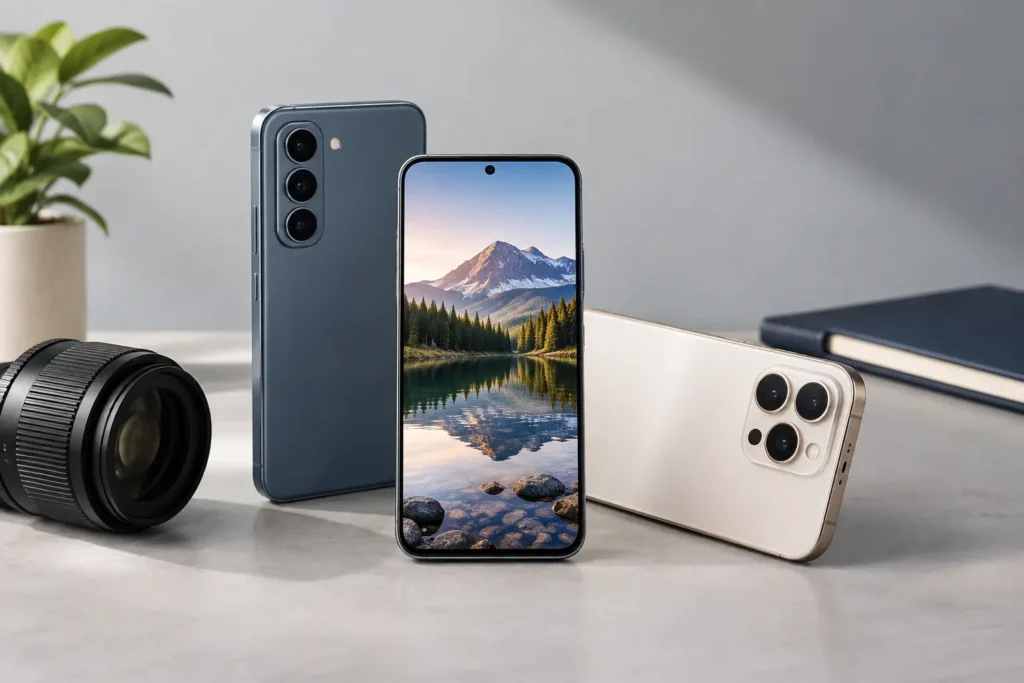
A phone camera can look excellent in a product listing and still miss the photos you care about. This smartphone camera buying guide focuses on the details that change real results: people in indoor light, city scenes after sunset, moving children, food, travel, and video.
The right choice depends less on the largest megapixel number and more on the main camera, image processing, lens selection, and the way you normally shoot. Start with your own photo library. If most of your images are portraits, night scenes, and short clips, buy for those situations rather than for a specification you may use twice a year.
What should you prioritize in a smartphone camera buying guide?
Prioritize the main camera first. It takes most of your photos, and it usually determines whether the phone feels dependable every day.
A strong main camera combines a relatively large sensor, a bright lens, optical image stabilization, and consistent processing. These elements work together. A large sensor can collect more light, stabilization helps keep exposures sharp, and processing controls color, detail, and noise.
Do not judge a camera by resolution alone. A 50-megapixel or 200-megapixel sensor often combines neighboring pixels into one larger effective pixel for typical shots. That can produce a very good 12-megapixel photo, but the headline number does not guarantee better dynamic range, skin tones, or low-light detail.
Look for independent full-resolution samples taken in conditions similar to yours. Product photos are useful for understanding the lens arrangement. They do not show how the camera handles a dim restaurant, bright midday contrast, or a face near a window.
Does sensor size matter more than megapixels?
Sensor size usually matters more than megapixels for image quality in difficult light. A larger sensor generally captures more light and can produce cleaner shadows, better subject separation, and a wider range between bright and dark areas.
Manufacturers do not always present sensor sizes in an easy format, so use them as one signal rather than the only deciding factor. A well-tuned smaller sensor can make more pleasing images than a larger sensor with inconsistent processing. Still, when comparing two phones in the same price range, the better main sensor is often the safer choice.
Lens aperture also matters, but it should not be read in isolation. An f/1.7 lens lets in more light than an f/2.2 lens when other factors are comparable. Yet sensor size, stabilization, shutter speed, and computational processing can have a larger effect on the final photo.
Optical image stabilization is particularly valuable. It moves the lens or sensor slightly to counter hand movement during a longer exposure. This helps with night photography and can make handheld video appear calmer. Electronic stabilization is useful too, but it usually crops the image and cannot fully replace optical stabilization.
Which camera lenses will you actually use?
Most shoppers will use a main wide camera and a moderate telephoto camera more than any other lenses. An ultrawide camera is valuable for architecture, interiors, landscapes, and group shots, but quality varies significantly between models.
A useful camera system usually has three distinct views: a main camera for everyday photos, an ultrawide for more of the scene, and a telephoto for distant subjects or more natural portraits. The quality should remain reasonably consistent across all three. A sharp main camera paired with a weak ultrawide can be frustrating when traveling.
Be cautious with extra rear cameras added primarily to increase the camera count. A low-resolution macro or depth sensor may have limited practical value. Modern portrait modes can often create a convincing background blur using the main camera and depth information from other sensors.
For zoom, optical reach matters. A dedicated 3x or 5x telephoto lens gives the phone genuine detail at that range, while digital zoom enlarges and reconstructs information from the main sensor. Digital zoom can still look good in bright light, especially on high-resolution sensors, but it becomes less reliable as the zoom level rises.
Periscope telephoto lenses are designed to fit longer focal lengths into a thin phone body by folding light through a prism. They can be excellent for travel, stage events, and distant architecture. They are less essential if you mostly photograph people, meals, and everyday moments at close range.
How do you judge low-light camera quality?
Judge low-light quality by looking at faces, moving subjects, highlights, and colors, not only by how bright the image appears. A phone can brighten a dark scene aggressively while smoothing away facial detail or turning warm indoor light gray.
Night modes usually capture several frames and combine them into one image. This can reveal buildings, streets, and static scenes very well. It is less effective when people move, cars pass through the frame, or you are shooting from a moving vehicle.
Check whether the phone can preserve bright signs and lamps without turning them into blank white shapes. Then inspect the shadows. Good processing retains texture without adding heavy grain or waxy smoothing. Skin should still look like skin, particularly under mixed restaurant lighting.
For buyers in the UAE, strong sunlight is another useful test. Look at how a camera handles pale buildings, reflective cars, and deep shadows beneath covered walkways. The best cameras retain detail in both the bright and dark parts of the frame without making colors look unnatural.
Is video quality as important as photo quality?
Video quality matters if you record family moments, social content, travel clips, or work presentations. Check stabilization, autofocus behavior, microphone quality, and lens switching before focusing on the maximum recording resolution.
A phone may record 4K video but still deliver unsteady footage, visible exposure shifts, or soft focus when a person walks toward the camera. Look for sample clips recorded while walking, indoors, and after sunset. These show far more than a static daytime test.
The front camera deserves the same attention if you join video calls often or record yourself. Resolution is secondary to natural skin tones, reliable focus, and exposure that does not darken your face against a bright background.
Creators may value log recording, high frame rates, external storage support, and manual controls. Most buyers do not need every advanced mode. A camera that produces attractive clips automatically is usually more useful than one that requires editing after every recording.
What should you compare before buying?
Compare phones using the same set of real-life questions. This keeps the decision clear when specification sheets start to look similar.
- How does the main camera perform indoors without flash?
- Is there optical image stabilization on the main camera and telephoto camera?
- Does the ultrawide camera have autofocus for close subjects and sharper edge detail?
- Is the stated zoom optical, sensor-crop, or fully digital?
- Do portrait photos preserve hair, glasses, and skin texture naturally?
- Can the phone switch between lenses smoothly during video?
- How much storage will your photos and 4K video require over two or three years?
Storage is easy to overlook. High-resolution photos, burst shots, and 4K video fill a phone quickly. Choose more internal storage if the model does not accept a memory card, especially if you prefer keeping original files on the device.
Battery life also affects camera use. Long video sessions, navigation, editing, and mobile data can drain a phone faster than expected. A compact power bank can be practical on full travel days, but it should complement a phone with dependable battery life rather than compensate for poor endurance.
Should you choose iPhone or Android for the camera?
Choose the phone whose camera behavior and wider system suit you, not the label on the back. Both iPhone and Android models can produce excellent photos, but they may make different choices about contrast, color, sharpening, and skin tones.
Some people prefer a more consistent point-and-shoot result across photo and video. Others value long telephoto reach, manual controls, or the flexibility to process images later. Visit a store when possible, hold the phone, and compare the camera interface. A camera you can operate quickly is more likely to capture the moment.
Also consider the people you share with. If your family exchanges photos through a particular service, or your work depends on a certain platform, that experience can matter as much as a small difference in image detail.
When is it worth paying more for a camera phone?
Pay more when the upgrade gives you a better main sensor, a useful telephoto lens, stronger low-light results, or video features you will use weekly. It is less worthwhile when the extra cost mainly adds a higher zoom number or an additional low-value camera.
A considered camera purchase starts with the images you want to keep, not the specifications you want to compare. Choose the phone that makes those images easier to take well, whether that is a quiet dinner, a weekend trip, or an ordinary afternoon worth remembering.
