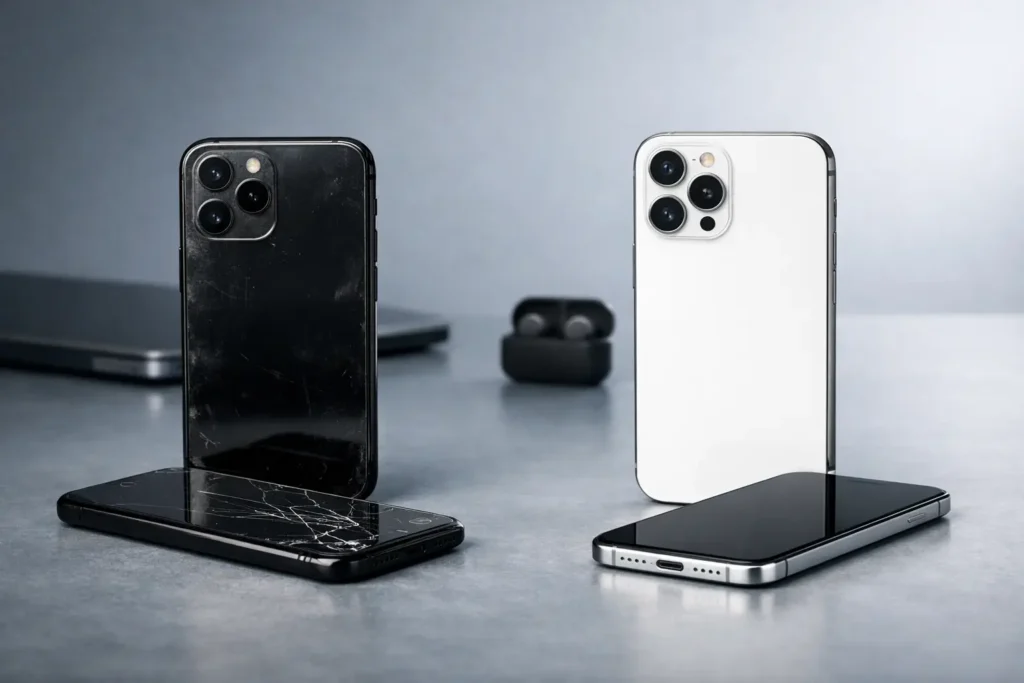
A flagship phone from two or three years ago can still shoot excellent photos, run demanding apps, and feel more refined in the hand than a newly released entry-level model. That single fact is why “refurbished vs new smartphones” is a genuine decision in the UAE, not a simple question of who spends less. The right answer depends on what you use your phone for, how long you plan to keep it, and how much certainty you want from the purchase.
It’s a decision most of us in the Emirates make more often than we’d like. A screen finally gives out, a two-year contract ends, a family member needs their first phone, or the summer heat quietly finishes off a tired battery. In that moment, a new device offers a clean starting point, while a refurbished one can put a higher tier of hardware within the same budget. Neither is automatically the smarter buy. What actually decides value is the detail behind the label: condition, battery health, software support, and how honestly the seller describes it all.
What a refurbished smartphone should mean
A refurbished smartphone is a previously owned device that has been inspected and prepared for resale. Depending on the seller and the model, that process may include testing core functions, replacing faulty parts, cleaning the exterior, resetting the software, and grading cosmetic wear.
This is not the same as a used phone sold exactly as its previous owner left it. Refurbishment implies a defined process — but that process isn’t identical everywhere. One seller replaces any battery that falls below a stated health threshold. Another tests the battery and leaves it in place if it still performs. Some devices get replacement screens or housings; others keep minor marks from ordinary use.
That’s why the product description deserves more attention than the word refurbished itself. Look for a clear condition grade, a plain explanation of what was tested or replaced, and precise notes on the included accessories. A thoughtful listing lets you evaluate the device before it ever reaches your hand — which, when you’re buying a refurbished iPhone or Samsung online rather than in a shop, is the whole game.
Refurbished vs new smartphones: the real differences
A new smartphone arrives unused, with its original components and the full software life cycle starting at the moment you buy it. It’s the most straightforward choice for anyone who wants the latest features, pristine materials, and the longest possible runway for operating-system updates.
A refurbished smartphone changes the value equation. It can place a former premium model within a budget that would otherwise buy a basic new device — meaning a brighter display, better cameras, more capable processing, stronger build materials, or a more polished design. For someone whose day runs on calls, maps, photography, messaging, and media, those differences are felt far more than a yearly spec bump.
The trade-off is variation. New devices are consistent. Refurbished devices are individual units, and their condition can differ even within the same grade. A well-restored example is an excellent buy. A vaguely described one leaves too many questions unanswered.
Price is only the first part of value
It’s tempting to line up two purchase prices and stop there. The more useful comparison asks how the phone will serve you over the next two or three years. A cheaper refurbished model with little remaining software support may not be the better value at all if you rely on it for work, travel, banking, and daily life.
Flip it around, and a refurbished recent-generation model may carry enough remaining updates and performance to make a brand-new midrange phone look less compelling for the money. The goal was never to own the newest phone. It’s to buy the right level of phone for the length of time you expect to keep it.
Storage belongs in the same calculation. A phone that’s short on storage turns frustrating fast once photos, video, work files, and offline media pile up. Compare storage capacity directly — don’t assume a premium older model is better configured than a current new one.
Quick tip: Work out a rough “cost per year of use.” A recent refurbished flagship at AED 1,200 you’ll keep three years often beats a new budget phone at AED 800 you’ll replace in eighteen months — once battery and software support are factored in.
Battery health deserves close attention — especially here
Battery condition is the most practical question in any refurbished purchase, and the UAE climate raises the stakes. Every rechargeable battery holds less charge as it ages, and sustained heat accelerates that decline. A phone can look immaculate yet need topping up by mid-afternoon if its original battery has already spent a couple of Gulf summers in a warm pocket, a hot car, or direct sun.
So ask the direct question: was the battery tested, replaced, or measured against a stated standard? If the listing gives a battery-health figure, treat it as meaningful information, not fine print. Your own habits matter too. Someone who works near a charger and mainly uses the phone to communicate may find a good original battery perfectly fine. A frequent traveller, a mobile professional, or a heavy camera user is better off with a replaced battery — or a new phone.
New smartphones win on this point by default: the battery starts unused. Even so, battery life is shaped by display size, processor efficiency, network use, and software — a new low-cost phone doesn’t automatically outlast a carefully refurbished premium one.
Software support sets your ownership horizon
A phone’s age affects far more than its appearance. It affects how long the manufacturer will keep providing operating-system upgrades and security updates — and in the UAE, that’s not a technicality. UAE Pass, banking apps, government and Emirates ID services, and everyday two-factor logins all assume a phone that still receives security patches. Support should be one of your first checks on any older refurbished model, not an afterthought.
A phone that’s still powerful but nearing the end of its support window can be an excellent secondary device, a lighter user’s first phone, or an affordable short-term option. It’s a weaker choice as a primary device you intend to keep for years. New smartphones generally offer a clearer update horizon, especially when they’ve only just launched, and that predictability has real value. Before choosing refurbished, pin down the exact model year and confirm where it sits in its software life cycle.
Cosmetics and materials are personal
A new device is untouched, and for some buyers that matters deeply. The unmarked screen, the original finish, the fresh packaging — that’s part of the experience, especially when the phone is a gift.
A refurbished phone may carry faint marks on the frame or back even when the display and performance are flawless. A clear condition grade keeps expectations aligned. Small signs of prior ownership are easy to accept when they buy you a better camera system or more premium construction. They’re harder to accept when the phone is a milestone purchase or a gift where presentation is the point. A case can protect a phone, but it shouldn’t be used to excuse vague grading — cosmetic condition should be disclosed plainly and judged on its own terms.
New or refurbished? A quick read
- Buy new if → you want the latest camera and connectivity features, the longest software support, and an untouched battery, and you’d rather not compare condition grades at all.
- Buy new if → you need a specific current-generation capability — a newer connectivity standard, advanced on-device processing, or a camera feature tied to the newest hardware.
- Consider refurbished if → performance and camera quality matter more to you than owning the newest release, and you want a higher-tier device for a set budget.
- Consider refurbished if → it’s a second phone, a travel device, or a young user’s first smartphone — provided it’s clearly assessed and recent enough to still get updates.
- Either works when → the model is matched to the owner. The best refurbished pick is rarely the oldest flagship going; it’s a recent, well-documented model with healthy software life and a condition grade you’re comfortable with.
A smarter way to make the decision
Start with the role the phone will play. If it’s your main device for work, photography, navigation, and daily life, weigh battery condition and software support before finish colours or small spec differences. If it’s a secondary device, the balance tilts back toward price and capability.
Then compare by generation, not marketing tier. A recent midrange new phone can offer better long-term support than an older premium device; an older premium device can offer a noticeably better display, camera, and build. Both are sensible when matched to the right owner. Before you commit, run a quick check:
- Model year — identified, and its place in the software-support cycle confirmed.
- Battery — tested, replaced, or given a stated health figure.
- Storage — enough for two or three years of photos, video, and files.
- Condition grade — described plainly, with any cosmetic wear disclosed.
- Accessories — what’s actually in the box, stated clearly.
- The seller — describes all of the above openly, before you buy.
That last point carries the rest. Buy from a source that describes the phone with care — condition, battery information, storage, included accessories, and model details should all be easy to find. Clear information isn’t a nicety; it’s part of a considered purchase, especially for a device you’ll use every day.
The real measure of value
The best phone is the one whose condition, capabilities, and remaining life feel proportionate to your routine — not the one with the lowest number on the page or the newest one on the shelf. A new device gives you a clean, long-term starting point. A carefully chosen refurbished model gives you more phone where it counts. The value lives in knowing exactly which trade-off you’re making, and making it on purpose.
