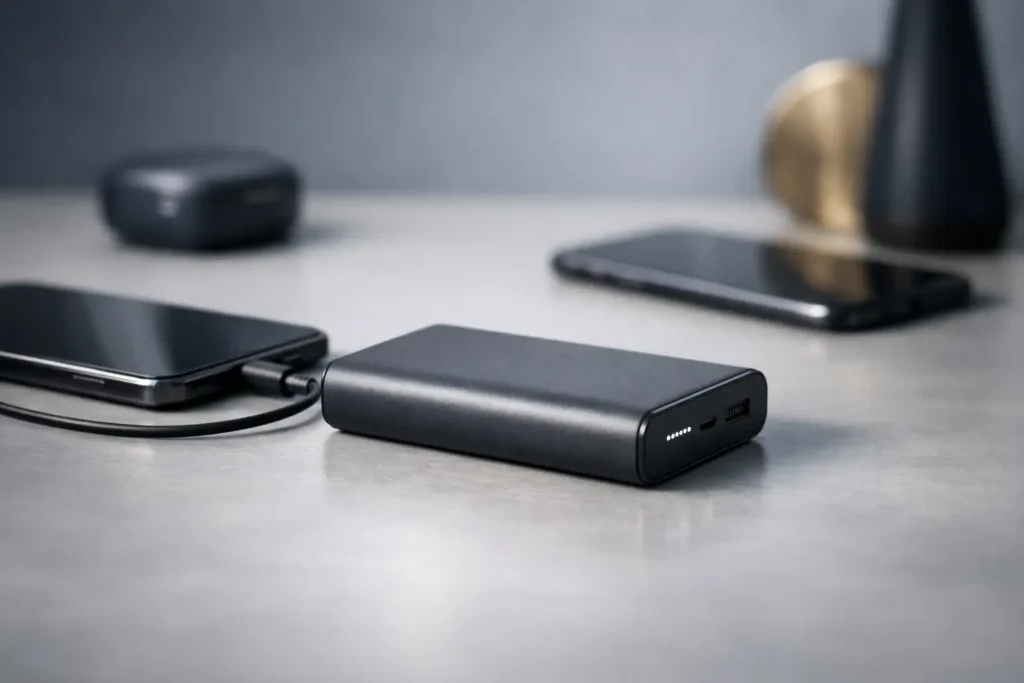
It is 4 p.m., your phone is at 18 percent, and your next meeting is on the other side of Dubai, not the other side of the room. In that moment a power bank stops being a gadget and becomes the difference between arriving prepared and arriving apologetic. That is why searches for a 10000mAh power bank price in the UAE are rarely just a hunt for the lowest number. The sharper question is what that number actually buys you: dependable charging, a shape you will carry without thinking, the right ports for your devices, and a battery you can trust after an afternoon in a warm car.
A 10,000 mAh power bank is the practical middle ground for most people living in or travelling through the UAE. It slips into a work bag or a carry-on, adds meaningful power to a modern phone, and skips the bulk of heavier models. Prices here vary widely, and understanding why is the first step to spending well rather than simply spending little.
10000mAh Power Bank Price in the UAE: What the Ranges Tell You
It helps to think of the market in three bands, because each one solves a different problem.
At the entry level, a basic 10,000 mAh power bank often starts somewhere around AED 40 to AED 70. At this level you can expect straightforward charging, a plastic housing, and one or two USB outputs. These models suit occasional use, such as a spare in the car, a desk drawer, or a weekend bag. The trade-offs are usually slower charging, a less refined finish, and limited information about the battery cells or protection features.
The most considered band tends to sit between AED 70 and AED 130. Here you begin to find slimmer designs, USB-C input and output, clearer battery indicators, and genuine fast-charging support. This is where a power bank stops feeling like an emergency item and starts feeling like an everyday accessory. It is also where most people find a genuinely useful fast charging power bank in Dubai, one that can top up a phone between appointments rather than only overnight. For a professional carrying a phone, wireless earbuds, and perhaps a second device, this range usually offers the best balance of price and utility.
Premium compact models can run from AED 130 to AED 220 or more. That higher price rarely means the battery charges your phone twice as many times. More often it reflects a smaller footprint, aluminium detailing, higher output wattage, an integrated cable, a more polished finish, or a recognised specialist manufacturer. In other words, you are usually paying for build quality and carryability, not extra charges.
One caution ties the bands together. Prices move with stock, promotions, bundle contents, and product generation. A newer USB-C model can cost more than an older design with the same stated capacity, which is exactly why the specification panel matters more than the capacity figure printed on the front.
Why Two 10,000 mAh Models Can Cost So Differently
If two power banks share a capacity but not a price, the gap is hiding in the details. Four of them matter most.
The first is charging speed. A standard output is fine for a slow overnight top-up, but it drags when a phone needs power in the twenty minutes between meetings. A higher-wattage USB-C output changes that for compatible phones and tablets. Read the rating in watts rather than trusting a phrase such as “fast charge”, because a 20W output is a different tool from a basic low-wattage port even when both use the same words.
The second is bidirectional USB-C. Some power banks use USB-C only to refill themselves. Better ones let that same port charge your phone or tablet as well. If you have already standardised on a single USB-C cable, as most recent iPhone and Android users now have, this small specification quietly removes friction from every day. It is one of the most underrated things to look for in a USB-C power bank for travel.
The third is cell quality and safety, which rarely appears clearly on a product page yet separates a battery that ages gracefully from one that fades fast. A reputable model should protect against overheating, excess current, overcharging, and short circuits. These are not glamorous features, but they earn their place on a device that lives beside your phone, laptop, and travel documents.
The fourth is design. A genuinely slim pack, like the kind built for ultra-slim daily carry, can cost more because the internal layout is tighter to engineer. A textured grip helps in the hand, and a digital percentage display can tell you far more than four small LEDs when you need to know whether the battery is ready for a long day out. None of these details is essential for everyone, but together they explain why similar capacities carry different prices, and why the best slim power bank in the UAE is seldom the cheapest one on the shelf.
Read the Capacity With a Little Context
A 10,000 mAh figure describes the battery’s cell capacity in milliampere-hours, not the exact energy that reaches your phone. Some energy is always lost as voltage is converted and pushed through the cable. Real-world results also shift with phone size, battery health, temperature, and whether you are using the phone while it charges.
In practice, a 10,000 mAh power bank gives most current smartphones roughly one and a half to two full charges under ordinary conditions. Larger phones receive a little less, and smaller phones a little more. Ask it to also top up earbuds or a smartwatch, and that energy is shared across all of them.
This does not make a 10,000 mAh model a compromise. It makes it a specific tool. It is well suited to a long workday, an evening event, a day of travel, or a busy weekend backup. If you routinely power several devices across multiple days, a 20,000 mAh model may suit you better, though it adds noticeable weight and takes longer to recharge.
Match the Ports to the Devices You Actually Carry
Before you decide that a lower price is the better value, look at what you carry. A modern phone with USB-C is best served by a power bank that offers USB-C output, which is the most direct answer for anyone shopping for a power bank for an iPhone in the UAE that has moved to USB-C. If you still use a device with a USB-A cable, a second port can help, though two outputs sharing one battery often means slower charging when both are active.
An included cable can be convenient for a compact travel setup, but it should not be the reason to choose a model. Check that its connector matches your phone, that it supports the stated charging speed, and that it can be replaced. An integrated cable is neat right up until it is the one part that wears out.
Also consider how the power bank itself refills. A model that accepts higher-wattage input is ready again sooner, provided you already own a compatible wall charger. If it only accepts low-wattage input, the compact size may be welcome, but topping it back up can take much longer.
Heat, Travel, and Everyday Care in the UAE
The local climate deserves its own consideration. Lithium-ion batteries do not enjoy extreme heat, and the UAE supplies plenty of it. Avoid leaving a power bank in a parked car, on a sunny windowsill, or pressed against a heat source. If a unit ever feels unusually hot, stop using it until it returns to a normal temperature. A well-made product has safety controls, but sensible storage remains part of battery care.
For air travel, a 10,000 mAh power bank is one of the easier capacities to carry, since at about 37Wh it sits well below the 100Wh threshold most airlines apply. Keep it in your cabin baggage rather than checked luggage, and confirm the policy for your particular airline before you fly, because the rules do differ between carriers. Our guide to the UAE cabin rules covers the current requirements in detail.
A power bank also does not need to reach 100 percent after every short use. Partial charges are perfectly normal. What matters more is using a suitable cable, keeping the ports clean, and avoiding drops that can damage the housing or the cells inside.
A Short Checklist Before You Buy
Before you settle on a model, confirm a handful of practical details. Look for a USB-C output stated in watts rather than a vague “fast charge” label, and check whether that USB-C port is bidirectional so it can charge your phone and not only refill the bank. Confirm that the safety protections are listed, that the battery indicator is clear enough to read at a glance, and that the recharge input matches a wall charger you already own. Finally, be honest about the shape and weight, because the best power bank is the one you will actually bring with you, and check that a 10,000 mAh model, at around 37Wh, sits comfortably under the cabin limit for your flights.
Read the specification panel with the same critical eye you would give any everyday tool. The usable details, capacity, wired input and output, output wattage, dimensions, weight, safety protections, and what is included in the box, say far more about long-term satisfaction than a dramatic product claim.
A Better Way to Judge Value
The lowest 10000mAh power bank price in the UAE can be a perfectly reasonable choice when the device is only an occasional backup. But for daily use, value shifts. It is often wiser to prioritise a magnetic power bank or a wired model with real USB-C output, honest power ratings, dependable safety features, and a shape you will genuinely bring with you.
So reframe the purchase. A power bank is not a standalone number on a price tag. It is one part of a small personal system that includes your phone, cable, charger, and bag. The right one is not the model with the longest feature list or the shortest price. It is the one that quietly removes a little friction from your day, then disappears back into your bag until the next time your phone dips to 18 percent, and this time you will not even slow down.
