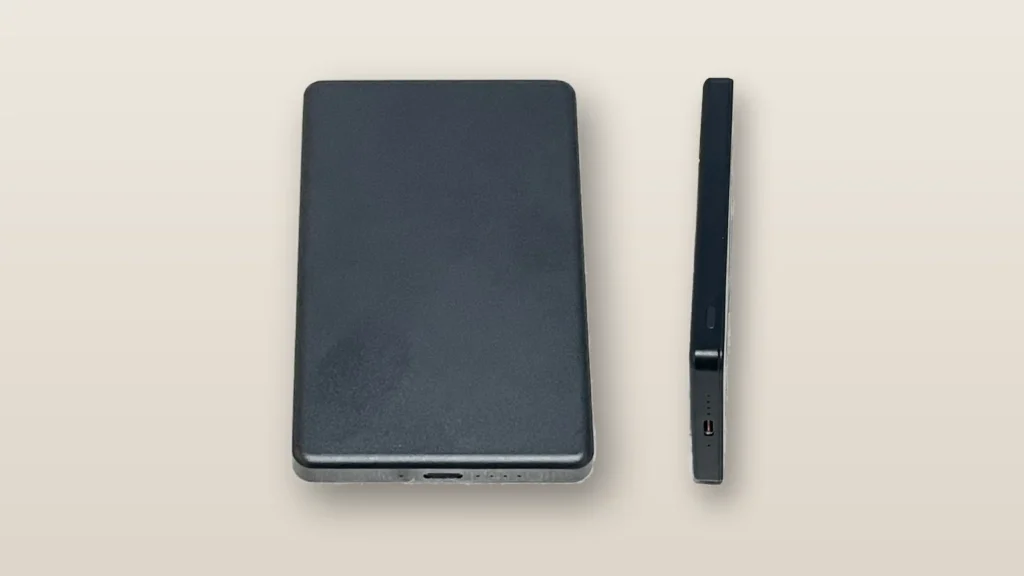
A wireless power bank is a portable battery that charges your phone without a cable, usually through a magnetic pad on its back. The right one is not the one with the biggest number on the box. Instead, it is the one whose capacity, output, fit and size suit the way you carry your phone.
This guide turns that idea into seven checks you can run in a minute on any product page. Each check links to a deeper Journal guide if you want more detail. Sultão, one of the Toko stores, sells a magnetic power bank, and we use it as a worked example near the end. The checks themselves apply to any brand.
The wireless power bank checklist at a glance
- Capacity in Wh, not only in mAh
- Output, with the USB-C and wireless figures listed separately
- Magnetic alignment, if you want to use the phone while it charges
- Fit with your phone and the case you already own
- Thickness and weight you will happily carry every day
- Flight rules: under 100 Wh, and in your cabin bag only
- Protection circuits, a written warranty and a full spec sheet
What is a wireless power bank?
A wireless power bank is a battery pack with a charging coil built into one face. You place the phone on it, and the coil sends energy across a few millimetres without a cable. Most models also have a USB-C port for wired charging. Magnetic models add a ring of magnets, so the phone and the coil stay lined up.
The wireless part follows the Qi standard, which the Wireless Power Consortium manages. Qi support is what lets one bank charge many brands of phone. Magnetic attachment, however, is a separate feature. A phone can support Qi without having any magnets at all. Our phone charging standards guide explains how Qi, USB-C and Power Delivery fit together.
1. Capacity: read Wh as well as mAh
mAh tells you the size of the battery cells. Wh, or watt-hours, tells you the stored energy, and it is also the figure airlines use. To convert, multiply the mAh by the cell voltage (usually 3.7 V) and divide by 1,000. So a 10,000 mAh bank holds about 37 Wh.
However, the number on the box is not what reaches your phone. Some energy is lost when the voltage is converted, and more turns into heat during wireless charging. Sultão’s own figures for its 10,000 mAh model are a useful example: roughly 7,500 mAh by cable and roughly 5,000 mAh wirelessly. In other words, use the cable when you need the most out of a charge.
For most people, 10,000 mAh is the sweet spot. It adds a full day of use without making the phone heavy. On the other hand, if you only need a top-up between meetings, a smaller bank may suit you better. Our 10000mAh power bank value guide compares what that size costs in the UAE.
2. Output: find out where the watts go
Output in watts (W) shows how fast a bank can push energy into a device. The catch is that one headline number often hides three different ones. For example, a bank can have a high maximum output, a lower USB-C rate and a lower wireless rate again. So look for a spec sheet that lists each figure separately:
- Maximum output: the most the bank can supply at once, often shared across two ports.
- USB-C Power Delivery: the fast wired rate. USB Power Delivery is the standard that lets the bank and the phone agree on a higher wattage.
- Wireless output: the rate through the charging face, which is normally the lowest of the three.
Your phone sets the final speed, not the bank. The cable, the case, the temperature and what the phone is doing all play a part. Therefore, treat every watt figure as a ceiling rather than a promise.
3. Is magnetic wireless charging worth it?
Yes, if you want to keep using your phone while it charges. The magnets hold the bank in place as you pick up the phone, reply to messages or follow a map. As a result, no cable pulls at the bottom of the phone, and there is nothing to unplug in your bag.
That said, magnetic charging favours convenience over speed. Wireless charging creates more heat than a cable, and phones slow their charging when they get warm. This matters in the UAE, where a phone used outdoors in summer heats up quickly. So use the magnetic face for steady top-ups through the day, and switch to the USB-C port when you need a fast refill.
4. Will a wireless power bank fit your phone and case?
Check three things before you buy: wireless charging, magnets and your case. First, confirm that your phone supports Qi wireless charging. Next, check whether it has built-in magnets. Many recent iPhones do, while most Android phones need a magnetic case or a stick-on ring.
Finally, look at your case. A thick or non-magnetic case can weaken the hold, push the coils out of line or stop charging altogether. Also check the camera bump, because it can stop a bank from sitting flat. Our guides to MagSafe case compatibility and how to verify MagSafe compatibility include a one-minute test you can run at home.
5. Thickness and weight: the carry check
A magnetic bank spends most of its life stuck to your phone. Because of that, its size matters more than it would for a bank that lives in a bag. A thick bank makes one-handed use awkward. A heavy one drags the phone down in your hand, and sooner or later you stop carrying it.
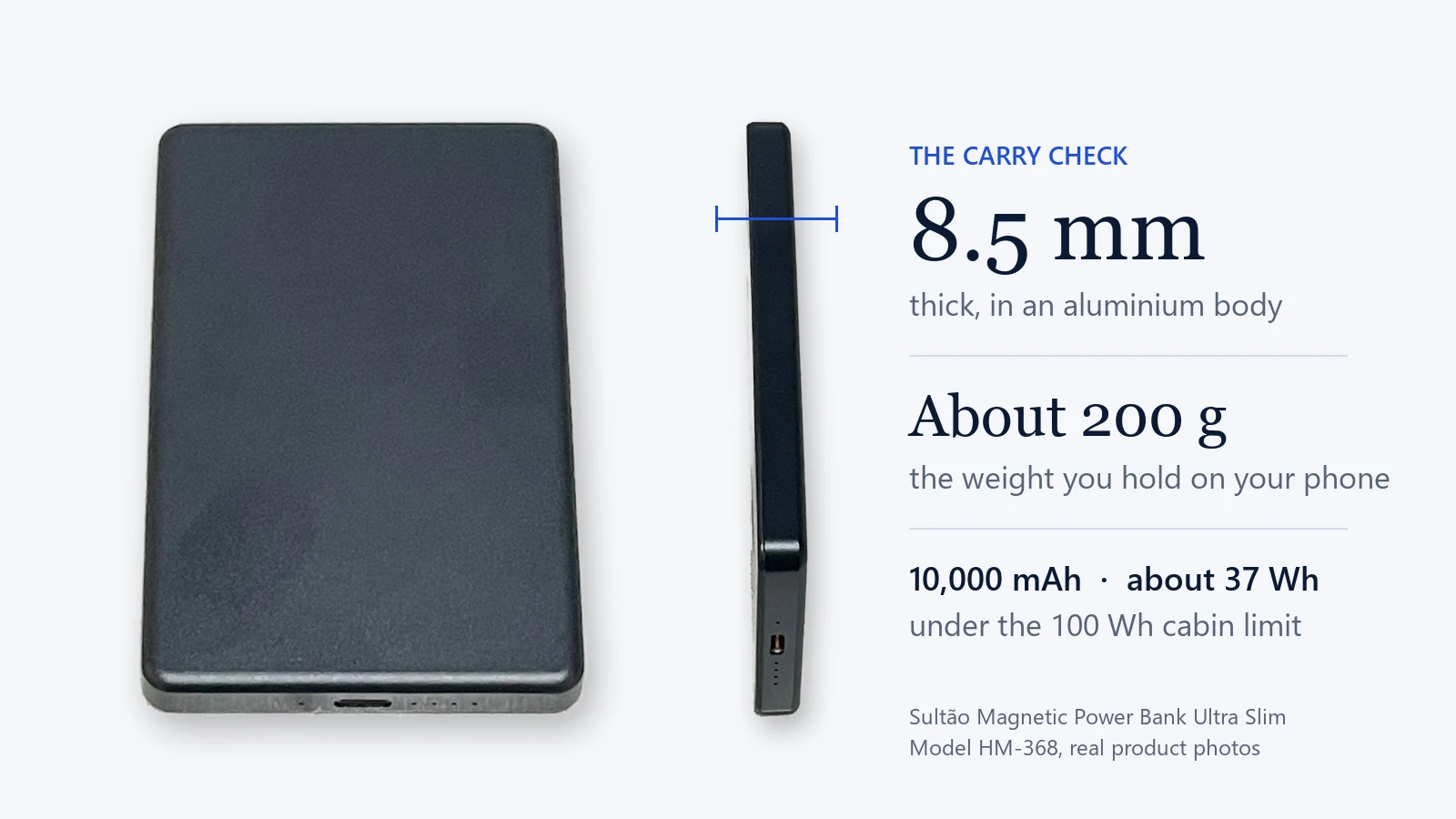
For reference, the bank above is 8.5 mm thick and weighs about 200 g at 10,000 mAh. That makes a useful benchmark when you compare spec sheets. Thinner banks usually hold less energy, while bigger ones hold more but cover more of the phone. If you commute daily, our pick of portable chargers for commuting weighs these trade-offs for a working day. In short, the best size is the one you will actually carry.
6. Can you fly with a wireless power bank in the UAE?
Yes, in your cabin bag, as long as it is under 100 Wh. Power banks are not allowed in checked luggage, because the crew must be able to reach a battery quickly if it overheats. A 10,000 mAh bank, at about 37 Wh, sits well under that limit.
Using one on board is a different matter. Emirates has banned the use of power banks on its flights since 1 October 2025, and that includes charging a phone from one. Other airlines set their own rules, and those rules change often. So check your airline’s current policy before you fly. Our guide to taking a power bank on a plane in the UAE covers the details.
7. Safety, warranty and a clear spec sheet
A complete spec sheet is itself a safety signal. It should list capacity in mAh and Wh, every output figure, the cell type and the protection circuits. Look for protection against over-charging, over-discharge, short circuits and overheating. On the other hand, a listing that only says “fast” or “works with all phones” is a warning sign.
Also check the warranty and who stands behind it. A seller with a UAE address and a written warranty is far easier to deal with than an anonymous listing. Finally, keep any power bank out of direct sun. A car dashboard in a UAE summer, for example, gets far hotter than lithium cells are designed to handle.
How one wireless power bank reads against the checklist
Here is the Sultão Magnetic Power Bank Ultra Slim, run through the same seven checks. We sell it, so we have kept strictly to its published specifications.
- Capacity: 10,000 mAh, about 37 Wh. Roughly 7,500 mAh by cable and 5,000 mAh wirelessly.
- Output: 22.5 W maximum, USB-C Power Delivery up to 20 W and 15 W magnetic wireless output.
- Magnetic fit: a MagSafe-compatible magnetic ring, and it also works with any Qi-enabled phone.
- Size: 8.5 mm thick and about 200 g, in a matte black aluminium alloy body.
- Flight: well under the 100 Wh cabin limit, so it travels in your cabin bag.
- Safety and warranty: over-discharge and short-circuit protection, plus a 12-month warranty.
- Price and delivery: AED 145, delivered within the UAE in 2 to 5 business days. Delivery costs AED 25 and is free on orders over AED 250.
For the hands-on verdict, read our magnetic power bank review. Alternatively, see the full specification on the product page.
Wireless power bank FAQ
How many phone charges does a 10,000 mAh wireless power bank give?
It depends on your phone’s battery and on how you charge. By cable, a 10,000 mAh bank gives about two full charges for a typical smartphone. Wirelessly, expect noticeably less, because more energy turns into heat.
Does a wireless power bank work with Android phones?
Yes, if the phone supports Qi wireless charging. However, most Android phones have no built-in magnets, so you need a magnetic case or ring to hold the bank in place.
Is wireless charging slower than charging by cable?
Usually, yes. Wireless charging loses more energy as heat, and phones slow down when they get warm. For the fastest refill, use the USB-C Power Delivery port instead.
Will my phone case stop wireless charging?
A thin magnetic case usually works well. In contrast, a thick, rugged or non-magnetic case can weaken the hold or stop charging. If in doubt, run the quick test in our MagSafe case guide.
Can I use a power bank on a flight from the UAE?
Not on Emirates, which banned in-flight use from 1 October 2025. You can still carry one under 100 Wh in your cabin bag. Check other airlines’ rules before you travel, because they differ.
In short, a wireless power bank earns its place when it takes friction out of your day. Run the seven checks, match them to your phone and case, and the right choice becomes clear.
