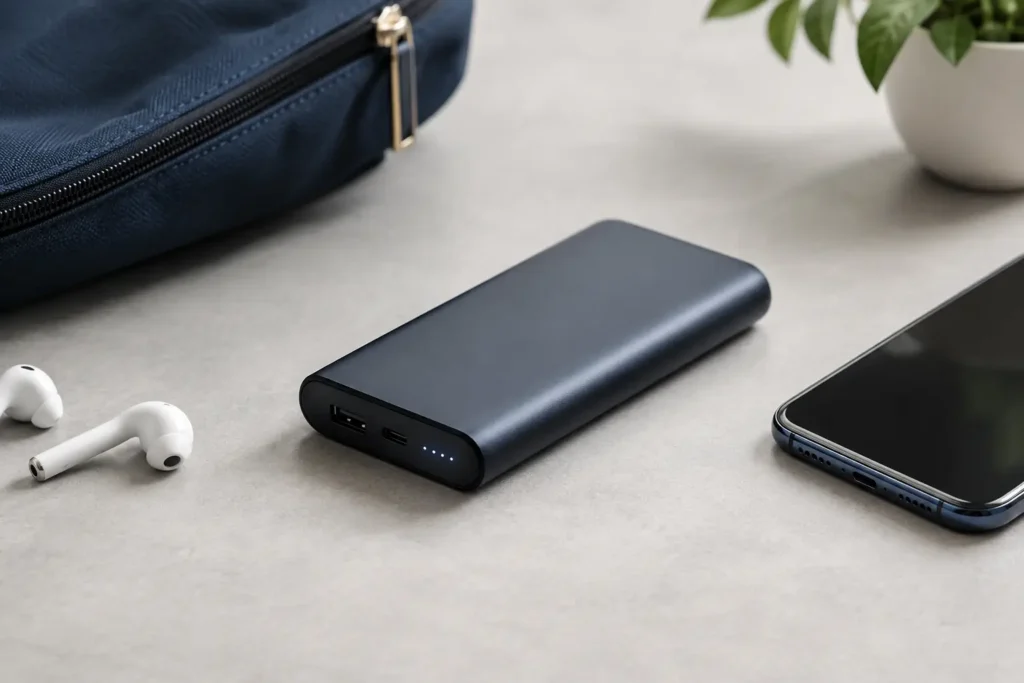
A 10,000mAh power bank is the capacity most people can carry every day without turning a pocket, work bag, or travel pouch into a hardware drawer. This 10000mAh charger review focuses on the details behind that number: usable charge, charging behavior, magnetic convenience, heat, and the compromises worth accepting.
For an iPhone user who needs one dependable top-up between meetings, a slim 10,000mAh charger is usually the sensible middle ground. It offers materially more reserve than a 5,000mAh model while remaining easier to live with than a larger 20,000mAh unit.
Is a 10000mAh charger enough?
For most phones, 10,000mAh is enough for a full recharge in normal use, often with some energy left over. The exact result depends on the phone’s battery size, its age, the charging method, cable quality, and what the phone is doing while it charges.
The number printed on a power bank measures the cells inside it, not the energy that reaches your phone. Power is lost as voltage is converted and as heat is produced. A 10,000mAh model should therefore be judged as a practical one-phone solution, not as a promise of two exact full charges.
That distinction matters when comparing products. A compact magnetic power bank may be the better choice for a daily commute, even if a cable-based model delivers slightly more usable energy. If you regularly charge a phone, tablet, headphones, and another person’s device, 10,000mAh can feel limited. In that case, capacity matters more than slimness.
What does a 10000mAh charger review need to test?
A useful review should look beyond the capacity label. The right charger is defined by how it fits the devices you use and the moments when you need it.
Charging speed is not the same as capacity
Capacity tells you how much energy is stored. Output tells you how quickly that energy can be delivered. A 10,000mAh bank with a suitable wired output can be a strong choice for a fast midday top-up. Magnetic wireless charging is more convenient, but it is generally less efficient and creates more heat than charging by cable.
Consider how you charge at 4 p.m., not only what the specifications say. If your phone sits on a desk while you work, a cable is simple and efficient. If you are walking between appointments, traveling by car, or using maps, magnetic charging keeps the phone usable without a dangling cable.
A practical model should also recharge through a current USB-C connection. It reduces the number of cables you need to carry and suits newer phones, tablets, and laptops. Check the included cable and the port arrangement before buying. A small accessory can create unnecessary friction when it requires a separate cable you do not otherwise use.
Magnetic alignment changes the experience
Magnetic power banks make most sense for MagSafe-compatible iPhones and compatible magnetic cases. The magnet centers the charger over the charging coil, so you do not need to balance a phone on a pad or hold it in a specific position.
The trade-off is thickness. A power bank attached to the back of a phone changes how the device feels in the hand. Ultra-slim designs reduce that effect, but any external battery adds weight and depth. A case with a weak magnetic ring can also reduce security, particularly when the phone is being used one-handed.
Test the fit with your case in mind. The charger should sit flat, remain aligned when you pick up the phone, and leave the camera area unobstructed. A power bank that slips or blocks comfortable use is unlikely to become an everyday carry item, whatever its capacity.
Heat deserves attention
Warmth during charging is normal. Excess heat is a reason to change how you charge, especially when using wireless power. Avoid placing a charging phone under a pillow, in direct sun, or inside a tightly packed bag.
Heat can also make a phone slow down charging. This is not necessarily a fault with the power bank. It is often the phone managing temperature to protect its battery. If speed is the priority, use a cable and let the phone rest on a hard, ventilated surface.
How portable should a 10,000mAh charger be?
A 10,000mAh charger should earn its place in your daily bag. Its physical dimensions, weight, edge shape, and finish matter as much as its capacity when you carry it for months.
Very thin models are particularly useful when paired magnetically with a phone. They feel less awkward during messages, rideshare bookings, boarding passes, and maps. A slightly thicker model may offer more ports or stronger wired performance. Neither is automatically better. Choose based on whether your power bank is primarily attached to your phone or stored until needed.
A durable surface is useful for keys-and-bag life, but texture can collect dust. Smooth finishes are easier to wipe clean, while matte finishes often feel more secure in the hand. These are small decisions, yet they affect whether an accessory stays on your desk or becomes part of your routine.
Can you travel with a 10,000mAh power bank?
A 10,000mAh power bank is approximately 37Wh when calculated at the common nominal cell voltage of 3.7V. That sits below the 100Wh threshold commonly published by airlines for spare lithium-ion batteries carried in cabin baggage.
Airline policies can differ, and they can change. Check your airline’s published rules before departure, particularly for connecting flights. Keep a power bank in your carry-on rather than checked luggage, and protect its ports from loose metal objects such as keys or coins.
For short trips, 10,000mAh is often the cleanest option. It can cover navigation, boarding documents, airport delays, and an evening out without adding the weight of a larger travel battery. For a long-haul journey with multiple devices, consider whether you need a larger reserve or simply a reliable charging outlet and one good cable.
Who should choose a magnetic 10,000mAh charger?
A magnetic 10,000mAh charger suits the iPhone user who values access as much as stored power. It is designed for the person who wants to attach a battery in seconds, stay connected while moving, and remove it when the phone is charged.
Sultão’s Magnetic Power Bank Ultra Slim has a 10,000mAh capacity, MagSafe compatibility, and a price of AED 145. Those specifications make it relevant for shoppers who prefer a slim magnetic format over a larger cable-first power bank.
It may not be the ideal choice for every setup. Android users without a compatible magnetic case, people who need to charge several devices at once, and travelers who routinely go multiple days without mains power may be better served by a different format. A purchase decision should start with your devices and charging habits, then move to capacity.
What should you check before buying?
Start with your phone model and case. Confirm that the magnetic connection is designed for your setup and that the charging position does not interfere with the camera or your grip.
Then check whether wired charging matters to you. A power bank that is excellent for emergency wireless top-ups may be less appealing if you want the fastest possible charge. Look at the ports, cable requirements, and stated input and output specifications rather than relying on capacity alone.
Finally, think about when your battery anxiety actually appears. If it is late afternoon after heavy navigation and calls, a slim 10,000mAh charger is a measured answer. If it is during weekend travel with a phone, tablet, earbuds, and camera, a larger battery may be the more honest choice.
The best power bank is the one you will carry before your phone reaches 5%. Choose a capacity that fits your day, a charging method that fits your hand, and a form factor that makes staying powered feel uncomplicated.
