A phone camera can look excellent on a product page and still miss the photos you care about. This smartphone camera buying guide turns that problem into seven checks: the main camera, sensor, lenses, zoom, low light, video, and storage with battery. Each check helps you buy for the way you shoot, not for the biggest number on the box.
Toko is a curated shop, not a camera lab, so this is a method rather than a ranking. We do not score phones. Instead, we show what to look for, what to ignore, and how to test a phone yourself in about ten minutes.
Smartphone camera buying guide at a glance
- Main camera first. It takes most of your photos.
- Sensor size and stabilization before megapixels. They decide results in dim light.
- Lenses you will really use. A good main camera, a usable ultrawide, and a telephoto if you shoot at a distance.
- Optical zoom, not digital zoom. Only optical zoom adds real detail at range.
- Low light judged on faces and movement. Brightness alone proves very little.
- Video judged separately. Check stabilization, focus, and the front camera.
- Storage and battery. Camera use drains both faster than you expect.
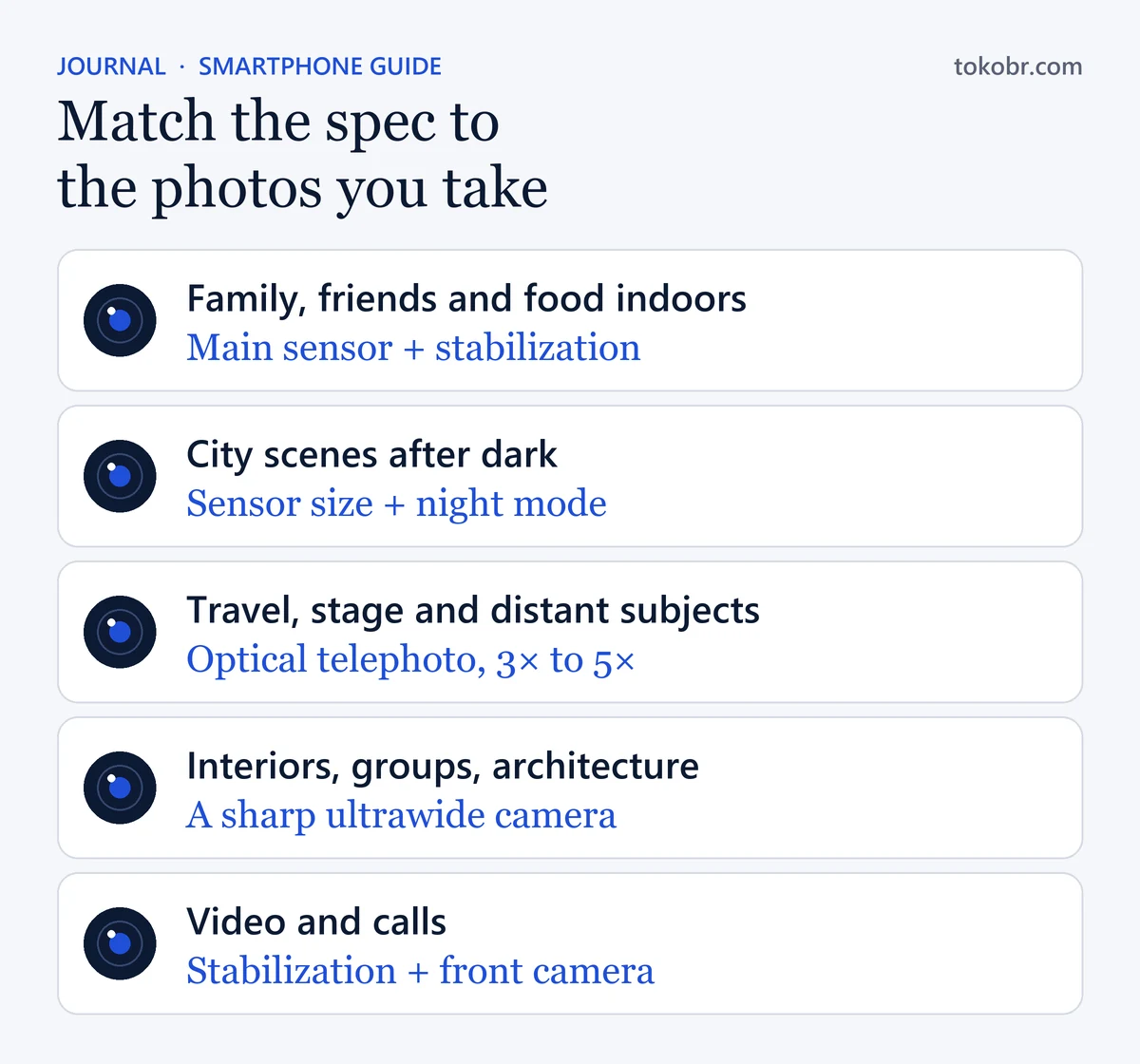
Start with your own photo library. If most of your pictures are people indoors, city scenes after dark, and short clips, buy for those. A specification you will use twice a year should not decide the purchase.
1. The main camera matters most
Prioritize the main camera first. It takes most of your photos, so it usually decides whether a phone feels dependable. A strong one combines four things: a relatively large sensor, a bright lens, optical image stabilization, and consistent processing.
These parts work as a team. The sensor collects light, stabilization keeps the exposure sharp, and processing shapes color, detail, and noise.
Product photos show the lens layout, but they cannot show how a camera handles a dim restaurant or a face in front of a window. Therefore, look for independent samples shot in conditions like yours. DXOMARK publishes its test method, for example. It shoots each test scene at least five times to check repeatability, and it tests in the default camera mode, because most people shoot that way.
2. Sensor size or megapixels: which matters more?
In difficult light, sensor size usually matters more than megapixels. A larger sensor captures more light, which gives cleaner shadows, better subject separation, and a wider range between bright and dark areas.
Megapixels describe resolution, not quality. Many high-resolution sensors group neighboring pixels into one larger pixel for everyday shots. For example, a 108 MP sensor can combine nine pixels into one to produce a 12 MP photo, and 200 MP sensors group even more. As a result, the headline number does not guarantee better skin tones, dynamic range, or night detail.
Manufacturers do not always list sensor size clearly, so treat it as one signal rather than the only one. A well-tuned smaller sensor can beat a larger one with poor processing. Still, between two phones at the same price, the better main sensor is usually the safer choice.
Aperture matters too, but not in isolation. An f/1.7 lens lets in more light than an f/2.2 lens when everything else is equal. However, sensor size, shutter speed, and processing often change the final photo more.
Optical image stabilization (OIS) is especially valuable. It moves the lens or sensor slightly to cancel hand shake during a longer exposure, which helps night photos and calms handheld video. Electronic stabilization helps too, but it crops the image and cannot fully replace OIS.
3. Which lenses will you actually use?
Most people use the main wide camera and one moderate telephoto more than any other lens. An ultrawide is valuable for architecture, interiors, landscapes, and group shots, but its quality varies a lot between models.
A useful system has three distinct views: a main camera for everyday photos, an ultrawide for more of the scene, and a telephoto for distant subjects or flattering portraits. Quality should stay reasonably consistent across all three. A sharp main camera paired with a weak ultrawide is frustrating on a trip.
Be wary of extra rear cameras added mainly to raise the camera count. A low-resolution macro or depth sensor has little practical value, and modern portrait modes can often blur a background convincingly without one.
4. Optical zoom or digital zoom?
For zoom, optical reach is what counts. A dedicated 3× or 5× telephoto lens captures genuine detail at that range. Digital zoom, in contrast, enlarges the image and rebuilds detail from the main sensor. It can look fine in bright light, particularly on high-resolution sensors, but it gets less reliable as the zoom level rises. So ask whether the stated zoom is optical, a sensor crop, or fully digital.
Periscope telephoto lenses fold light through a prism to fit a longer focal length into a thin body. They suit travel, stage events, and distant architecture. They matter less if you mostly photograph people, meals, and everyday moments at close range.
5. How to judge low-light quality
Judge low light by looking at faces, moving subjects, highlights, and colors, not just brightness. A phone can brighten a dark scene aggressively while smoothing away facial detail or turning warm indoor light gray.
Night modes usually capture several frames and merge them into one image. That works very well for buildings and still scenes. It is less effective when people move, cars pass, or you shoot from a moving vehicle.
Check three things in any night sample:
- Bright signs and lamps: do they keep detail, or turn into blank white shapes?
- Shadows: is texture preserved without heavy grain or waxy smoothing?
- Skin: does it still look like skin under mixed restaurant lighting?
UAE shoppers should add a daylight test as well. Strong sun is a harsh judge of pale buildings, reflective cars, and deep shadows under covered walkways. The best cameras keep detail in both the bright and the dark parts of the frame without making colors look unnatural.
6. Is video as important as photo quality?
Video matters if you record family moments, social clips, travel, or work presentations. Check stabilization, autofocus, microphone quality, and lens switching before you look at the maximum recording resolution.
A phone may record 4K and still deliver unsteady footage, visible exposure shifts, or soft focus when a person walks toward the camera. Look for sample clips recorded while walking, indoors, and after sunset. They show far more than a static daytime test.
The front camera deserves equal attention if you join video calls or record yourself. Natural skin tones, reliable focus, and an exposure that does not darken your face against a bright window matter more than resolution.
Creators may value log recording, high frame rates, external storage, and manual controls. Most buyers do not need every mode. A phone that makes attractive clips automatically is usually more useful than one that needs editing after every recording.
7. Storage and battery: the checks people forget
High-resolution photos, burst shots, and 4K video fill a phone quickly. A minute of 4K video can use well over 100 MB, and professional formats use far more. Choose more internal storage if the phone has no memory card slot, especially if you keep original files on the device. Our guide to how to choose phone storage shows how much is enough.
Battery life matters for camera use as well. Long video sessions, navigation, editing, and mobile data drain a phone faster than expected. On a full travel day, a compact power bank can help, and our wireless power bank checklist explains what to look for. A power bank should complement a phone with dependable battery life, not make up for poor endurance.
Smartphone camera buying guide: two phones read against the checks
Concrete examples help, so here are two flagship phones from our Sócio shelf, read against the checks. We have not lab-tested them. This is a reading of their published camera specifications, nothing more.
- Samsung Galaxy S25 Ultra: a 200 MP main camera. Check 2 applies. Ask how the phone combines pixels in everyday shots, and judge the result by real samples, not by the headline figure.
- Apple iPhone 16 Pro Max: a 48 MP Fusion camera system and a 5× telephoto. Check 4 applies. Confirm which zoom level you will use most, then compare 5× photos with main-camera photos after sunset.
Both phones are sold and shipped by noon, not by Toko. Links on the Sócio shelf are affiliate links, so Toko earns a small commission at no extra cost to you.
Smartphone camera buying guide: a ten-minute test before you pay
If you can visit a shop, or borrow a friend’s phone, run this test. It uses the same seven checks and takes about ten minutes.
- Shoot one indoor scene with the main, ultrawide, and telephoto cameras. Do color and sharpness stay consistent?
- Photograph a face beside a bright window. Does the skin look natural, or is it dark?
- Zoom to the lens’s labeled optical level, then to double it. Where does detail start to break down?
- Film someone walking toward you. Does focus keep up?
- Record 20 seconds of video while you walk, and switch lenses mid-clip. Is the footage steady, and is the switch smooth?
- Note the storage size, then ask yourself how much a year of 4K clips and burst photos would need.
For a deeper side-by-side method, read our guide on how to compare smartphone cameras. Buying online instead? Start with how to buy smartphones online in the UAE with confidence.
Smartphone camera buying guide FAQ
How many megapixels does a smartphone camera need?
Most people are well served by a final image of around 12 MP, which many 48, 50, 108, and 200 MP sensors produce after combining pixels. Extra megapixels help mainly when you crop heavily or print large. So judge the photo, not the label.
Is optical zoom better than digital zoom?
For detail at range, yes. Optical zoom uses a real telephoto lens. Digital zoom enlarges the picture and fills in detail with software. In bright light, digital zoom can look good up to a point, but it falls off quickly beyond that.
Which is better for the camera, iPhone or Android?
Neither wins every time. Both produce excellent photos, but they make different choices about contrast, color, sharpening, and skin tones. Some people prefer a consistent point-and-shoot result across photo and video. Others value long telephoto reach or manual controls. If your family shares photos through one service, that matters as much as a small difference in detail. Our iPhone 16 guide for the UAE covers the Apple side.
How do I use this smartphone camera buying guide in a shop?
Run the ten-minute test above, then rank each phone against the seven checks. Hold the phone, open the camera, and compare how quickly you can reach each lens. A camera you can operate fast is more likely to catch the moment.
When is it worth paying more for a camera phone?
Pay more when the upgrade gives you a better main sensor, a useful telephoto lens, stronger low-light results, or video features you will use weekly. It is less worthwhile when the extra cost mainly adds a higher zoom number or another low-value camera. Buying refurbished can also stretch a budget, as our guide to refurbished versus new smartphones explains.
In short, a considered camera purchase starts with the images you want to keep, not the specifications you want to compare. Choose the phone that makes those images easier to take well, whether that is a quiet dinner, a weekend trip, or an ordinary afternoon worth remembering.
