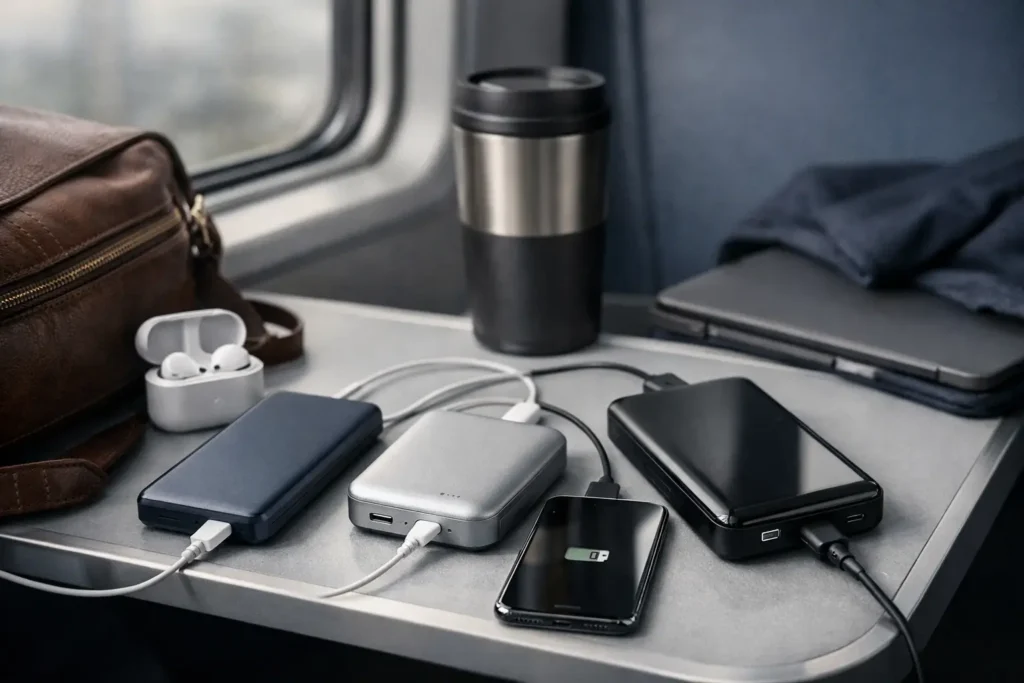
A phone at 12% changes the shape of a commute. Maps become something to ration, messages wait, and a late meeting can turn into a search for an open wall socket. The best portable chargers for commuting are compact enough to carry every day and sized to cover the gap between leaving home and returning to a charger.
For most commuters, a 10,000 mAh power bank is the sensible starting point. It offers useful reserve power without adding the weight and bulk of a larger travel battery to every bag, jacket pocket, or desk drawer.
What makes a portable charger right for commuting?
The right commuter charger balances capacity, thickness, charging method, and the devices you actually use. The largest battery is not automatically the best choice when it stays at home because it is too heavy to bring along.
A daily commute usually has a clear use case: keep one phone available through maps, mobile boarding passes, calls, music, and work messages. Someone carrying a phone and wireless earbuds has different needs from a commuter also charging a tablet, handheld console, or second phone.
Start with the days when your battery runs lowest. If a short ride and an office desk are your routine, a slim magnetic model may be enough. If you spend several hours between client meetings, drive often, or rely on your phone for navigation, capacity and cable charging become more valuable.
Capacity is useful only when you will carry it
Power-bank capacity is stated in milliamp hours, or mAh. This figure is useful for comparing models, but it is not a promise of an exact number of phone charges. Energy is lost during voltage conversion, cable charging, heat, and the phone’s own charging process.
A 5,000 mAh power bank is the lighter choice for a top-up. It suits a short day, particularly when your phone starts the morning near full. A 10,000 mAh model is more flexible for commuting because it can provide meaningful backup across a full workday and may support more than one small device.
Larger 20,000 mAh power banks make sense for long days away from outlets, regular tablet use, or weekend travel. They are less natural as daily carry. Their size can be worthwhile in a backpack, but less so in a trouser pocket or a small work bag.
Is a 10,000 mAh charger enough for a daily commute?
For one smartphone, 10,000 mAh is enough for most daily commutes. It is the middle ground between emergency-only capacity and a battery pack that feels like another device to manage.
The actual result depends on your phone’s battery size, its age, signal conditions, and how you use it. Navigation in a car, mobile data in low-signal areas, video calls, and high screen brightness all increase power use. A magnetic charger also trades some efficiency for the convenience of charging without a cable.
Choose 10,000 mAh when you want a charger that can live in your bag every day. Choose a larger capacity when you regularly charge two devices or know you will be away from mains power for much longer than a working day.
Should you choose magnetic or wired charging?
Magnetic charging is the easier option when you need a quick top-up while walking through a station, waiting for a ride, or moving between meetings. Wired charging is usually the more efficient option when speed and energy use matter most.
A magnetic power bank attaches directly to compatible phones, reducing the need to find and carry a separate cable. It is especially practical for a short charge during a commute or for holding a phone while using maps. The trade-off is heat and lower charging efficiency compared with a wired connection.
A cable remains the better choice for a longer charging session. It also works with a wider range of devices, including many Android phones, earbuds, and accessories, provided the ports and cable match. For some commuters, the best setup is a magnetic power bank plus a short cable kept in the same pouch.
A considered choice for magnetic phone charging
Sultão’s Magnetic Power Bank Ultra Slim has a 10,000 mAh capacity and MagSafe compatibility. At AED 145, it is designed for the commuter who wants practical battery reserve without the shape of a high-capacity travel pack.
Its appeal is not simply the capacity. An ultra-slim magnetic format is easier to keep close at hand: in a work tote, a jacket pocket, or beside a laptop during a meeting. It is a sensible fit when cable-free phone charging matters more than extracting the maximum possible efficiency from every charge.
Before choosing any magnetic charger, confirm that your phone supports the relevant magnetic charging system or has an appropriate compatible case. A case that is too thick, poorly aligned, or not magnetic can weaken the hold and affect charging performance.
What details should you check before buying?
Look beyond the capacity number. A well-chosen charger should match your phone, how you carry it, and where you expect to charge.
- Dimensions and weight: A charger that fits your daily bag will be used more often than a larger model reserved for travel.
- Port type: Check whether the input and output ports work with the cables you already own. USB-C is common, but cable and device compatibility still matter.
- Output and charging standard: Higher output can reduce charging time on compatible devices. Your phone and cable must also support the relevant charging standard.
- Number of outputs: One output is simple and slim. Multiple outputs are useful when you charge a phone and earbuds, or share power with another person.
- Magnetic compatibility: If you want cable-free charging, confirm the fit with your specific phone and case.
- Watt-hour labeling: If you fly with a power bank, check its watt-hour rating and compare it with your airline’s published battery limit before packing.
These details are not minor. A compact charger with the right port and a cable you already carry is more useful than a higher-capacity model that requires an extra adapter or does not fit your phone case properly.
How should you carry a power bank on the commute?
Keep the charger where you can reach it without unpacking your bag. A small internal pocket, tech pouch, or outer compartment works better than placing it loose beside keys, pens, and other hard objects.
If you use a cable, choose one short enough to avoid snagging but long enough to use your phone comfortably while it charges. Check the cable occasionally. Frayed connectors and bent ends are common reasons a power bank appears unreliable when the battery itself is working normally.
Heat deserves attention in the UAE. Do not leave a power bank in direct sun or inside a parked car for extended periods. Charge it on a hard, open surface when possible, and give both the phone and battery time to cool if either feels unusually warm.
When should you charge the charger itself?
Recharge your power bank after the commute that used it, rather than waiting for the next low-battery moment. A commuter battery is most useful when it is ready before you need it.
If you use it only occasionally, check its charge level every few weeks. This small habit avoids the familiar problem of carrying a power bank all day only to find it has too little power left to help.
The best commuter charger is the one that removes a small daily uncertainty. Choose the capacity you will carry, the charging method you will actually use, and a shape that belongs in your routine.
