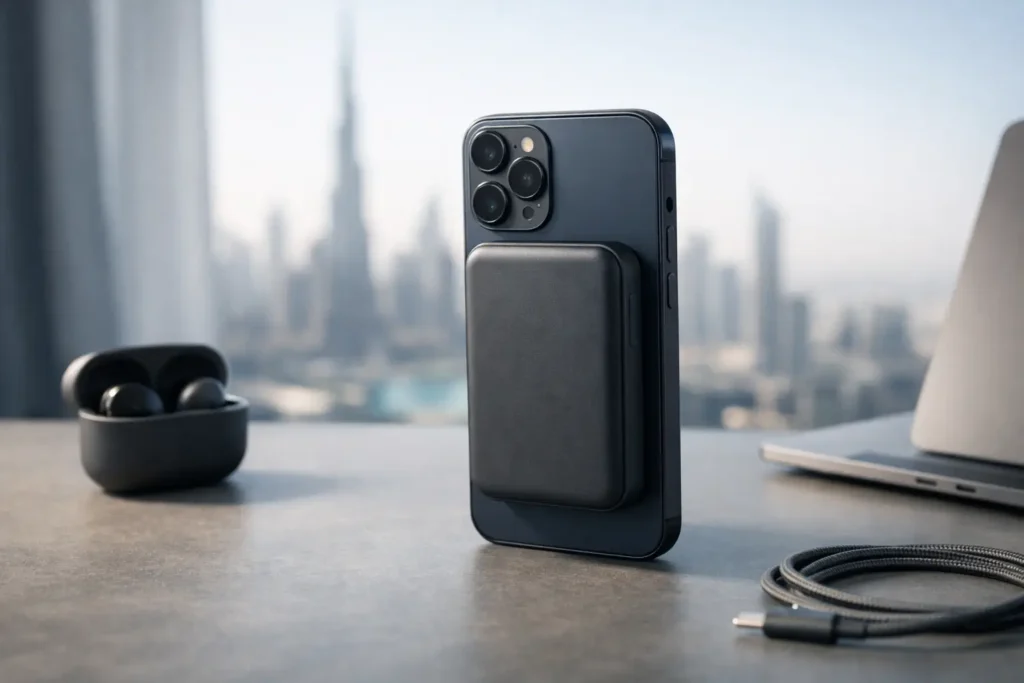
A magnetic power bank solves a familiar problem: your phone reaches the end of a long workday just as you need it most. Rather than carrying a cable and a separate battery in your bag, the pack attaches directly to the back of a compatible phone and begins charging. It is a small change in routine, but the right model feels notably more considered.
The category is not as simple as it first appears. Capacity, magnetic hold, wireless charging output, heat, thickness, and case compatibility all affect how useful a power bank will be in daily life. This guide works through each one in the order that actually matters, starting with the question that rules out the wrong models fastest.
Start With Your Phone and Case
The first question is compatibility. A magnetic power bank needs both a phone that supports magnetic alignment and a case designed to preserve that connection. A standard case, especially a thick one or one with a metal plate, can weaken the hold or prevent wireless charging altogether.
Look for a case described as compatible with your phone’s magnetic wireless charging system. The ring inside the case should align with the charging coil in the phone. When that alignment is correct, the battery settles into place with a confident hold and charges more consistently.
This matters beyond convenience. Poor alignment creates wasted energy and extra heat. It can also make the power bank easier to dislodge when you pick up the phone, place it in a pocket, or use it while walking. If you prefer a leather, textured, wallet-style, or especially protective case, check its construction before choosing the battery.
Capacity: Choose for the Day You Actually Have
Capacity is measured in milliampere-hours, usually written as mAh. It is useful, but it does not translate directly into a full number of phone charges. Wireless charging loses some energy as heat, and the phone’s own battery size also varies. A 5,000 mAh magnetic power bank will not restore a 5,000 mAh phone battery from zero to 100 percent.
That gap between the number on the box and the charge you actually receive is the reason capacity deserves a real decision rather than a default.
A 5,000 mAh pack is the minimalist choice. It is slim enough to leave attached while replying to messages or taking calls, and it disappears into a jacket pocket. Expect a meaningful top-up rather than a full refill. If your phone reliably reaches evening above 30 percent and you simply want insurance, it is enough.
A 10,000 mAh pack is the choice for a full spare day. It carries roughly double the reserve, which in practice is the difference between topping up and not thinking about the battery at all. The trade-off is real: more weight, more thickness, and a slightly less elegant object against the phone. Modern ultra-slim designs have narrowed that gap considerably, but they have not erased it.
Three UAE-specific factors tend to push the decision toward the larger capacity. Heat causes phones to drain faster and charge more slowly, so the reserve gets consumed quicker than the specification suggests. Long days that run from an office to a mall to a dinner leave little access to an outlet. And navigation, mobile data, and photography, the things people use constantly here, are among the heaviest battery loads there are.
Think in battery habits, not specifications alone
If you usually begin the day fully charged and need help only after 5 p.m., the smaller capacity will serve you. If your phone often starts the afternoon below 30 percent because of video calls, photography, hotspot use, or navigation, the larger pack removes the problem instead of postponing it.
Also consider whether the battery will live in a jacket pocket, work tote, car, or travel pouch. The best magnetic power bank is the one you will still bring with you. A large model left at home is less useful than a slim one that stays in your bag, which is why slimness matters as much as raw capacity in the larger sizes.
Wireless Speed Is Only Part of the Story
Magnetic power banks usually offer wireless charging at a lower output than a wired wall charger. This is normal. Wireless charging prioritizes convenience and alignment, not the fastest possible refill.
A higher wireless output can be useful when you need a quick lift before leaving the office or arriving at a meeting. Yet real-world results depend on the phone, its temperature, its battery level, and what it is doing while charging. Streaming video, using maps, and taking calls can slow the net gain because the phone continues consuming power.
Many power banks also include a USB-C port. This adds flexibility. You can recharge the power bank itself, and in many cases use a cable to charge your phone or another small device more efficiently. For a traveler carrying earbuds, a wearable, or a second phone, that port can be more valuable than an extra increment of wireless speed.
Check whether wired input and output are available at the same time if that is a feature you expect to use. Some batteries support pass-through charging, meaning the battery can recharge while it charges another device. Others do not. It depends on the model, and it is worth confirming before building it into your desk or bedside routine.
Heat Is a Design Question, Not a Minor Detail
Wireless charging naturally produces more heat than a cable. A well-designed magnetic battery manages that heat through efficient components, sensible charging behavior, and a housing that does not trap warmth against the phone.
Some warmth is expected, particularly in the UAE when a phone has been in a warm car, near a window, or outdoors. Excessive heat is different. It may cause charging to slow or pause while the phone protects its battery. For that reason, a magnetic power bank is best used out of direct sun and away from enclosed, hot spaces.
Do not judge a model only by its stated output. A modestly rated battery that maintains stable charging at a comfortable temperature can be more useful than one that begins quickly but repeatedly throttles. Look for clear product details about temperature protection and the wireless charging standards the model supports. Specific information is a better signal than vague claims about performance.
Thickness, Finish, and Magnetic Hold
A magnetic battery becomes part of the phone’s silhouette, so physical design matters. A thin, rounded pack is easier to hold while typing. A larger rectangular one may offer more capacity but can cover the camera area on some phones or make the device awkward to use one-handed.
The surface finish affects the experience as well. A soft-touch or matte exterior can feel secure and refined and resists fingerprints, while a smooth plastic shell is easier to wipe clean. A built-in stand can be useful for watching a flight update, following a recipe, or joining a video call, though it may add thickness. Choose it when you will use it, not because it looks clever in a product photo.
Magnetic strength needs balance. The battery should remain secure during normal use without being difficult to remove. Stronger magnets can be particularly useful with heavier phones and cases, but alignment matters more than brute force. A properly positioned ring and a case made for magnetic charging do most of the work.
Consider Travel and Everyday Carry
For travel, look at the battery’s watt-hour rating, which should be printed on the unit or its packaging. A 10,000 mAh pack is rated at about 37Wh, comfortably under the 100Wh threshold the major UAE carriers apply. Since October 2025, Emirates, Etihad, and flydubai permit one power bank per passenger in cabin baggage only, require the capacity to be clearly labelled, and no longer permit using it during the flight. Our guide to the UAE’s cabin rules for power banks covers the details, including where the pack must be stored.
Two practical consequences follow. Keep the power bank in your carry-on with its capacity label visible, and charge your phone before boarding rather than counting on doing it in the air.
At home or at work, magnetic charging is best treated as a convenient extension of your power routine. Use it for a top-up during a commute, between meetings, or while waiting for an appointment. When you have time and need the fastest recharge, a quality cable is often the more efficient choice.
This is not a limitation of the category. It is simply the distinction between portable convenience and maximum charging speed. The most useful setup often includes both.
A Short Checklist Before You Buy
Before selecting a model, confirm four practical details: your phone and case support magnetic wireless charging, the capacity suits your normal day, the dimensions do not interfere with your camera or grip, and the battery includes the port or stand features you will genuinely use.
Then read the specifications with a critical eye. Look for the usable details: battery capacity, wired input and output, wireless output, dimensions, weight, safety protections, the watt-hour rating printed on the casing, and what is included in the box. These details say more about long-term satisfaction than a dramatic product claim.
Sultão’s magnetic power bank was chosen against exactly this checklist: 10,000 mAh in an ultra-slim body, USB-C for wired charging, 22.5W maximum output, and 15W magnetic wireless output. Like most compact banks it prints its output rating in watts rather than its capacity in watt-hours; at a nominal 3.7V, 10,000 mAh works out to roughly 37Wh, well inside every UAE carrier’s 100Wh cabin limit. The distinction is worth knowing if you fly often: watts describe how fast it charges, watt-hours are what airlines measure. It is one product rather than a wall of options, which is the point.
A magnetic power bank is at its best when it disappears into your routine. It should feel natural on the back of your phone, dependable when your battery dips, and compact enough that bringing it along never becomes a second thought.
