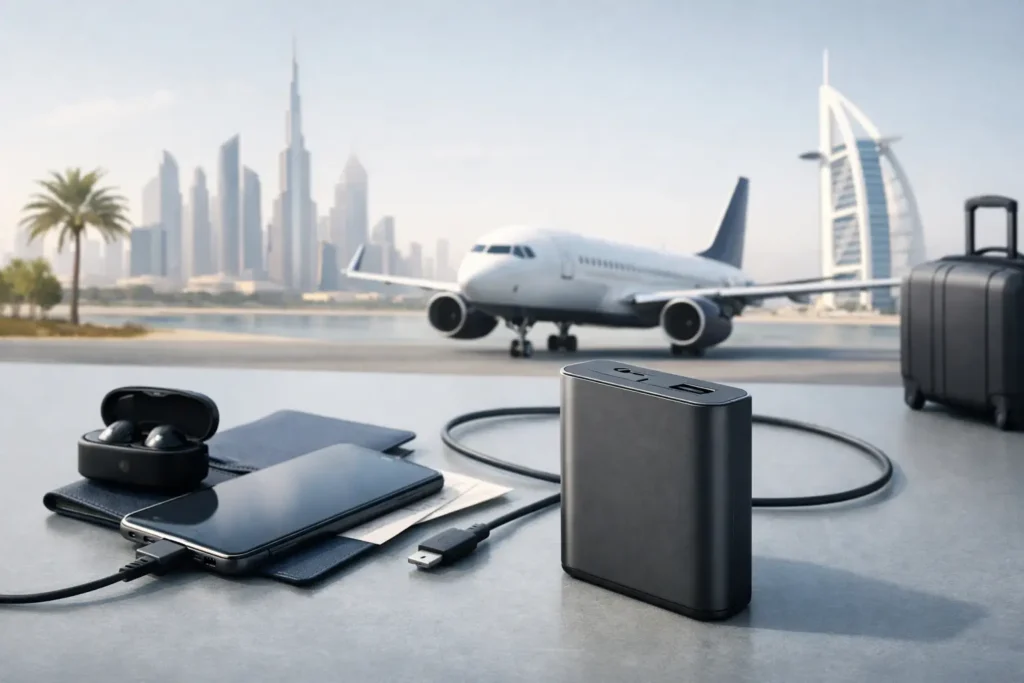
Yes — but the rules changed, and most travel advice online is now out of date.
Since 1 October 2025, Emirates, Etihad and flydubai all permit one power bank per passenger, in your cabin bag only, rated 100 watt-hours (Wh) or less and clearly labelled. What changed is the part nobody expects: you may no longer use it in flight. Not for your phone, not for a laptop, not for anything.
So the honest answer is that a power bank is no longer something you rely on during a UAE flight. It is something you carry legally, keep within reach, and use the moment you land.
The short answer
- Cabin only. Never in checked baggage. Lithium cells must be somewhere crew can reach them.
- One per passenger. Emirates, Etihad and flydubai each cap you at one. Choose it carefully.
- 100Wh or less. Above this you need advance approval — and Emirates simply says under 100Wh.
- Clearly labelled. The Wh rating must be readable on the casing. Unmarked batteries get refused.
- No in-flight use. You cannot charge devices from it, or charge it from an aircraft socket.
- Not in the overhead bin. Seat pocket, or a bag under the seat in front of you.
Emirates provides in-seat charging on all aircraft, and now recommends you simply arrive with your devices fully charged.
The rule most people miss: carrying it and using it are different things
This is the change that catches travellers out. Your battery can clear security, be perfectly legal, and still sit unused for the whole flight.
The reasoning is straightforward. Lithium-ion cells fail most often while under load — charging or discharging. A battery quietly sitting in a seat pocket is a much smaller risk than one running warm under a blanket, and if something does go wrong, crew can reach it in seconds. Overhead bins were removed from the equation for exactly this reason: a bin fire is discovered late.
flydubai has gone further and confirmed you also cannot charge the power bank itself from an aircraft socket. Emirates says the same.
Follow the crew’s instructions even if the battery was waved through at security. Those are two different checks, run by two different people, against two different rules.
Check watt-hours, not just mAh
Shoppers compare power banks by milliamp-hours. Airlines don’t — they work in watt-hours. If the Wh rating isn’t printed on your battery, calculate it:
Wh = mAh × voltage ÷ 1,000
Most USB power banks run at a nominal 3.7V. That gives you:
- 5,000mAh — about 18.5Wh. Fine.
- 10,000mAh — about 37Wh. Fine, with a comfortable margin.
- 20,000mAh — about 74Wh. Fine.
- 27,000mAh — about 99.9Wh. Right at the line.
- 30,000mAh — about 111Wh. Advance approval required.
Anything above 160Wh is not permitted on a passenger aircraft at all.
The label matters as much as the number. Now that clear labelling is an explicit airline requirement, an unmarked battery can be refused even if its real capacity is modest. Security staff will not do the arithmetic for you.
How to pack it
Put the power bank in your hand luggage, in a pocket you can reach without unpacking — you may be asked to show it, and it needs to go in the seat pocket once you board.
- Protect it from short-circuiting. Etihad and flydubai both require this. Keep it in its retail packaging or a protective case, away from loose keys, coins, and metal accessories that could bridge its ports.
- Check its condition. Never travel with a battery that is swollen, cracked, leaking, or unusually warm. Replace it before the trip.
- Keep the label readable. Avoid batteries with worn, altered, or missing markings.
- If it’s 100–160Wh, contact the operating airline in advance. Etihad and flydubai may approve it; get that confirmed before you leave.
On a multi-carrier booking, the airline flying each sector sets the rules for that sector. A battery cleared for your outbound leg is not automatically cleared for the connection.
Where travellers get caught out
Phone-sized batteries are rarely an issue. A 5,000mAh or 10,000mAh unit sits far below every threshold in this article.
The problems cluster around three things:
Capacity that hides in plain sight. A high-capacity battery can look like an ordinary accessory and still exceed 100Wh once voltage is factored in. Laptop banks, packs with AC outlets, and some camera and drone batteries are the usual culprits.
Unmarked casings. Sleek, minimal designs sometimes omit the rating entirely. That used to be cosmetic. It isn’t any more.
The one-battery cap. Travellers who carry a small one for the phone and a big one for the laptop now have to choose at the gate.
Choosing one
With one battery permitted, the question shifts from how much can I bring to which single one do I want.
For most travellers, that argues for something under 100Wh with the rating clearly printed on it — the combination that generates no questions at any UAE checkpoint. A 10,000mAh unit is roughly two full phone charges, which comfortably covers a travel day plus the taxi at the other end. Larger batteries remain perfectly legal; they’re just heavier, and on a flight you can’t use either one anyway.
Sultão’s Magnetic Power Bank Ultra Slim is 10,000mAh — about 37Wh, comfortably under every UAE carrier’s limit. It’s MagSafe-compatible and Qi-enabled, so it snaps to an iPhone without a cable, and it’s slim enough to live in a seat pocket where the airlines now want it. AED 145, delivered across the UAE in 1–3 days.
Not for the flight itself — nothing is, now. For the moment you land.
Before you leave: check the label, put it in your cabin bag, and read your operating airline’s current policy. These rules moved once in 2025; they can move again.
