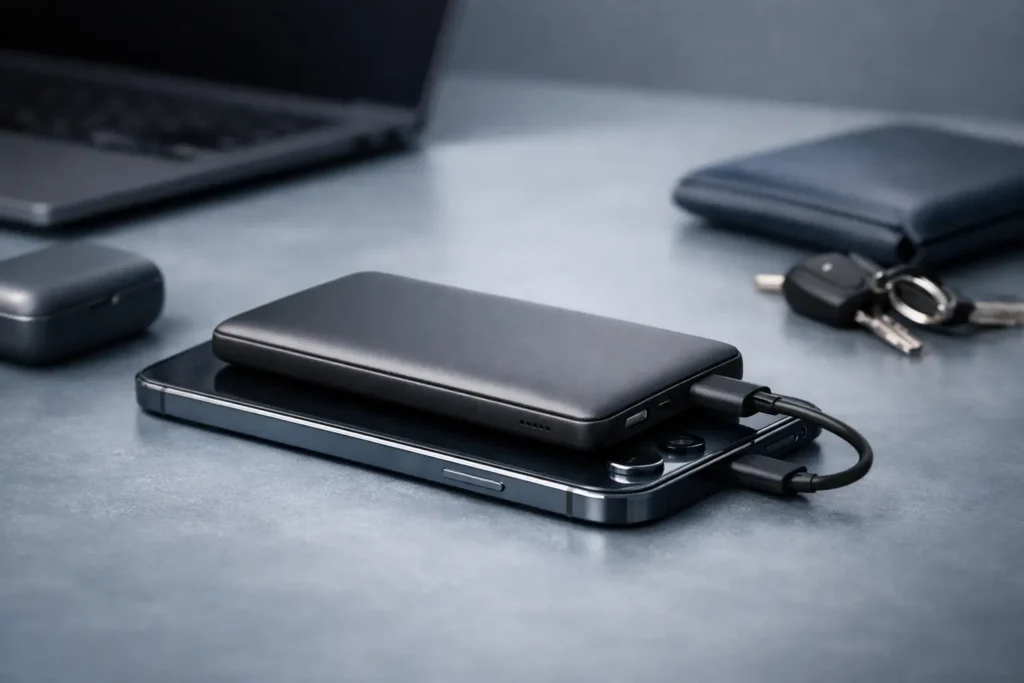
A phone at 12 percent changes the shape of a day. It makes a taxi ride, a client call, a long afternoon at a café, or a flight from Dubai feel more constrained than it should. An ultra slim power bank UAE shoppers can keep in a jacket pocket or work bag solves that problem without adding the bulk of another device.
The detail that matters is not just how thin it looks on a product page. A good slim power bank must suit the way you carry it, the phone you use, and the conditions around you. In the UAE, that also means accounting for heat, frequent time in the car, and the practical reality of charging more than one device during a long day.
Why a Slim Power Bank Is Worth Choosing
A large battery pack has a place. It is useful on a weekend trip, a full day of filming, or when two people need to share a power source. But it can become an object that stays at home because it is too heavy to bring along.
An ultra slim model is designed for a different role. It fits into the routines that create low-battery anxiety: the morning commute, an evening out, a conference, or a day moving between meetings. The best ones sit flat against a phone when connected by a short cable, or slip beside a wallet and keys without changing the feel of a bag.
Thinness does involve a trade-off. A very compact power bank generally cannot match the capacity of a thicker 20,000mAh model. For daily carry, that is often the point. You are choosing dependable top-ups over maximum reserve power.
Ultra Slim Power Bank UAE: Start With Capacity
Capacity is usually shown in milliamp-hours, written as mAh. It is a useful starting point, but it is not a promise of exactly how many full charges your phone will receive. Energy is lost through voltage conversion, cable resistance, background phone use, and heat.
For most people, a 5,000mAh slim power bank is the most portable choice. It can provide a meaningful boost to a modern phone and is easy to carry every day. It works well for someone who normally has access to wall power but wants a reliable backup before a meeting, dinner, or ride home.
A 10,000mAh model is the more versatile everyday option. It is usually still compact enough for a small crossbody bag or work tote, while offering around one strong phone recharge in real-world use, sometimes more depending on the device. If you use navigation, mobile data, video calls, or wireless earbuds throughout the day, this extra capacity is often worth a few additional millimeters.
Higher capacities are better for travel and shared use, but they are rarely ultra slim. Rather than chasing the highest number, consider the moment you expect to need power. A modest pack that is always with you is more useful than a high-capacity pack left in a desk drawer.
Pay Attention to Watt-hours for Flights
Airlines typically assess portable batteries by watt-hours, or Wh, not mAh. Most everyday power banks fall within the commonly accepted carry-on range, but airline rules can vary and may change. Portable batteries should generally travel in your cabin baggage, not checked luggage.
If you travel often, choose a model with capacity and regulatory markings clearly printed on the body. That small detail makes screening easier and gives you a clearer record of what you are carrying.
Charging Speed Is More Than a Number
A slim battery is only convenient if it charges your phone at a useful speed. Look at both output and input. Output tells you how quickly the power bank can charge a connected device. Input tells you how quickly the power bank itself can be replenished before the next day.
For a current smartphone, USB-C charging is the sensible baseline. A power bank with USB-C Power Delivery can offer faster charging when your phone and cable support it. The exact result depends on the phone’s charging limits, so a higher wattage rating does not automatically mean it will charge every device faster.
There is another trade-off here. Faster charging creates more heat, particularly when a phone is in use. For urgent top-ups, it is useful. For a phone sitting in a warm car or charging under direct sun, slower charging may be the more sensible choice. Keep both devices out of direct sunlight whenever possible, and avoid leaving a power bank in a parked vehicle.
A useful everyday design has one USB-C port that handles input and output. It reduces the number of cables you need to carry. A second port can be valuable if you charge earbuds or a second phone, though charging two devices at once will often divide the available power.
Cable, Wireless, or Built-In Connection?
The most efficient slim setup is usually a short USB-C cable. It is compact, works across many current devices, and tends to waste less energy than wireless charging. Choose a cable that is properly rated for the charging speed you expect, especially if you use a higher-wattage adapter at home or at work.
Magnetic wireless power banks offer a cleaner, cable-free setup. They are appealing when you need to check messages while charging or want a phone-and-battery pairing that stays together in one hand. Their compromise is heat and efficiency. Wireless charging can be slower, and the pack may feel warmer during use. In UAE summer conditions, a cable is often the more practical option for sustained charging.
Built-in cables remove one more item from your bag. They are convenient, but they also make the cable a fixed part of the product. Consider the connector you need and whether the cable length will feel comfortable while using the phone. A replaceable cable gives you more flexibility over time.
Size, Finish, and the Details You Feel Every Day
Product dimensions deserve more attention than most shoppers give them. A power bank can be technically thin but still wide or tall enough to feel awkward behind a phone. Compare its height and width with your device, particularly if you plan to use it while charging.
Weight matters just as much. A difference of a few ounces may not sound significant, but it is noticeable in a pocket or compact bag. For daily carry, the best balance is often a model with enough weight to feel well made, but not so much that you start leaving it behind.
Finish affects practicality. Matte surfaces tend to hide fingerprints and offer a more secure grip. Smooth metal can look refined but may become slippery. Rounded edges are more comfortable when the power bank rests against the back of a phone. A clear battery indicator is also helpful, especially before leaving home. Four small LEDs are simple and familiar; a percentage display is more precise.
Safety Marks and Battery Care
Choose a power bank from a manufacturer that clearly identifies its battery specifications and applicable safety certifications. Avoid products with unclear labeling, damaged ports, loose casing, or unusually light construction for their stated capacity. A power bank is not a place to compromise on basic build quality.
Lithium-ion batteries last longer when treated with reasonable care. Do not use a swollen, cracked, or overheating unit. Avoid covering the power bank with clothing or placing it under a pillow while charging. If it becomes uncomfortably hot, disconnect it and let it cool before using it again.
You do not need to run a battery to zero before recharging it. Regular, moderate charging is generally easier on the battery than repeated deep discharges. If a power bank will sit unused for an extended period, store it in a cool, dry place with some charge remaining rather than fully empty.
Choose for Your Actual Day
For a minimalist carry, a 5,000mAh USB-C power bank with a short cable is usually enough. It keeps a phone available without turning your pocket into a tech pouch.
For a workday that includes maps, calls, and earbuds, a slim 10,000mAh model offers more breathing room. Prioritize USB-C input as well as output, so the pack is ready again without an overnight wait.
For travel, choose capacity first, then confirm its watt-hour labeling and carry-on suitability with your airline. A slightly thicker model can be the better choice when wall outlets are uncertain. If wireless convenience is central to your routine, use a magnetic model for short top-ups and keep a cable nearby for more efficient charging when heat is a concern.
The right power bank should disappear into your routine until the moment it is needed. Choose the one you will actually carry, keep it charged before a busy day, and let a low battery remain a small inconvenience rather than a change of plans.
