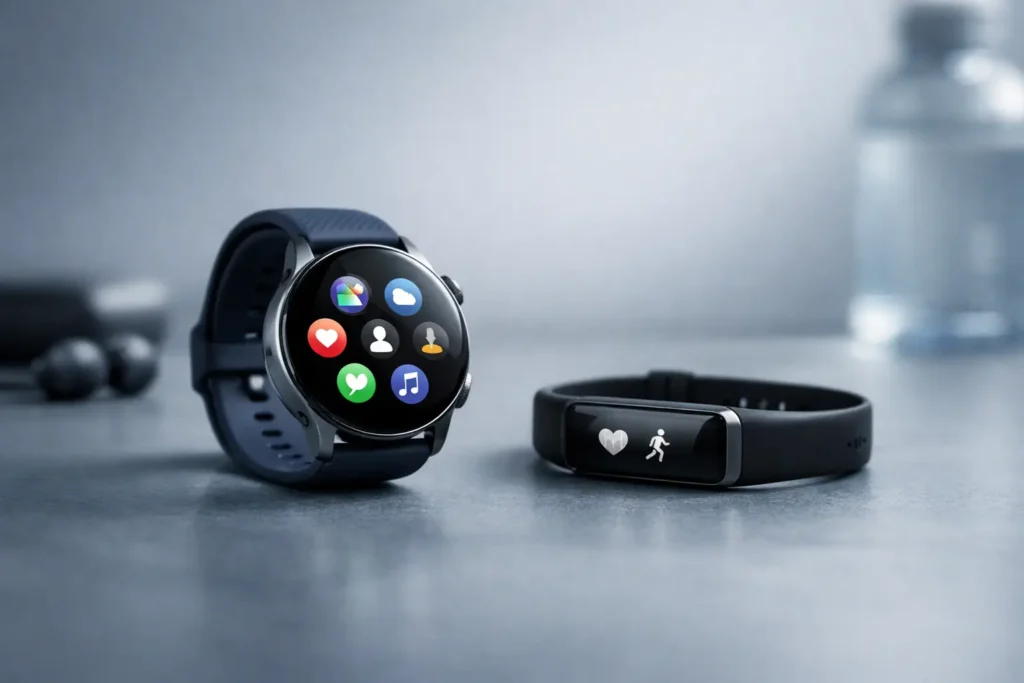
A wearable can change how you move through a day. It may quietly prompt you to stand after a long desk session, show a meeting alert while your phone is away, or reveal that a hard workout did not produce the recovery you expected. The smartwatch versus fitness tracker decision comes down to which of those moments matters most to you.
The two categories now overlap more than ever. Both can count steps, monitor sleep, record heart rate, and track walks or workouts. Yet they are designed around different priorities. A smartwatch is usually a compact extension of your phone. A fitness tracker is usually a focused health and activity companion. Choosing well means looking beyond the feature list and considering the device you will actually want to wear every day.
What actually separates the two — at a glance:
- Purpose — a smartwatch reduces phone use; a tracker builds a record of your body
- Battery — roughly 18–48 hours for a full-featured watch, 5–10 days for most bands
- Weight — a watch case typically sits at 30–60 g; a slim band is often 15–25 g
- Screen — large enough for maps and messages, or small enough to forget at night
- Cost of ownership — straps, charging cables, and the companion app behind it all
- The real test — which one you’ll still be wearing at 2 a.m. and on day nine
Smartwatch versus fitness tracker: the core difference
A smartwatch places daily convenience at the centre. Its larger screen, richer interface, and broader app support make it useful between workouts. You can read notifications, control music, check a calendar, follow navigation prompts, set timers, and in some cases make calls directly from your wrist. For an urban professional moving between work, training, and dinner, that reduced need to reach for a phone can be genuinely useful.
A fitness tracker takes a more concentrated approach. It is built to make activity, sleep, recovery, and long-term habits easy to see. The display is often smaller, the interface simpler, and the device lighter — which means it tends to disappear on the wrist, and a wearable you forget about is a wearable that keeps collecting data through the night.
Neither approach is inherently better. A smartwatch can track health in considerable detail. A fitness tracker can offer alerts and basic phone controls. The meaningful distinction is where each device puts its attention — and, just as importantly, what it asks of yours.
There is also a third path worth knowing about before you commit to either. A smart ring sits somewhere between the two: almost no screen, very low profile, strong overnight wear, and no attempt at phone-like convenience. If your entire interest is sleep and recovery, it may answer the question better than either category here.
Choose a smartwatch for everyday utility
A smartwatch suits someone who wants one wearable to serve several parts of the day. Its screen is typically bright enough for maps, messages, training metrics, and quick interactions. The broader interface also makes it easier to view data without opening a companion app on your phone.
This matters when convenience has a practical purpose. If you leave your phone in a bag during a commute, need a discreet reminder before a meeting, or want to change a playlist midway through a run, a smartwatch feels natural. It can also be a better option for people who enjoy changing watch faces and matching a wearable to different settings, from a gym session to a client lunch.
The trade-off is attention. More notifications, more apps, and a more capable screen can turn a watch into another source of interruption. A wearable meant to save you from your phone can quietly become a second one. The best smartwatch setup is often selective: keep the alerts that are useful, silence the rest, and let the device support your day rather than narrate it.
Choose a fitness tracker for consistency
A fitness tracker is often the better choice when health data is the reason you are shopping. Its modest screen and focused feature set can feel less like a miniature phone and more like a durable personal instrument. You wear it, forget about it, and review the patterns when they are useful.
That simplicity is what buys the battery life. Depending on the model and settings, many bands run 5–10 days between charges, while a watch with an always-on display and daily GPS workouts often needs the charger every night or two. Over a month, that is the difference between a continuous record and one with gaps precisely where the interesting data would have been.
Fitness trackers also tend to be smaller and lighter. This is not a minor detail. A wearable that feels comfortable through the night is more likely to produce meaningful sleep trends. A low-profile band may also be preferable if you do strength training, wear fitted sleeves, or simply dislike the weight of a traditional watch.
The compromise is limited flexibility. Reading long messages, using maps, or managing a busy stream of notifications is less pleasant on a compact tracker display. If you expect your wearable to reduce phone use during work and travel, that limitation can become clear quickly.
Battery life decides more purchases than features do
Charging sounds like a minor specification until it becomes a nightly task. It is worth being honest about your routine before you choose.
A watch that charges while you shower fits some lives perfectly. If you already dock your phone at your desk, adding a watch puck changes very little. But if you want uninterrupted sleep tracking, the charging window has to come from somewhere — and for most people, the only spare hour is the one they spend asleep.
Quick tip: Check what the device charges with, not only how long it lasts. A proprietary puck is one more thing to lose before a trip. If you travel often, a wearable that shares the charging setup you already carry — the same way a magnetic power bank removes a cable from your bag rather than adding one — is far more likely to stay powered.
Feature use also changes the number on the box. Always-on displays, continuous blood oxygen monitoring, GPS-tracked workouts, and on-wrist calling can each cut a stated battery estimate substantially. The quoted figure usually assumes a lighter pattern of use than an enthusiastic first fortnight.
Health features need context, not just numbers
Both types of wearable can provide useful signals: heart rate trends, activity minutes, sleep stages, blood oxygen readings on selected models, stress estimates, and workout summaries. These metrics are best treated as directional information. They can help you notice patterns, but they are not a substitute for medical assessment — and a confident-looking chart is not the same as a clinical one.
The quality of the experience depends on what you want to learn. A runner may value accurate route recording, pace visibility, and workout controls. Someone focused on recovery may care more about sleep duration, resting heart rate, and a clear view of how hard recent activity has been. A person beginning a healthier routine may only need step goals, gentle reminders, and a record that makes progress feel visible.
Before comparing specifications, identify the one or two health questions you want a wearable to answer. Perhaps it is whether you are sleeping enough on weekdays. Perhaps it is whether your afternoon walk is becoming a habit. Perhaps it is whether you are giving yourself adequate recovery after demanding training. The right device makes those answers easy to find.
For outdoor exercise in the UAE, screen visibility, water resistance, GPS reliability, and heat management deserve extra attention. A bright display is useful in strong sunlight, while a secure, comfortable band matters when workouts are warm. If swimming is part of your routine, check the device’s stated water rating and the specific conditions it is designed to handle rather than assuming all water-resistant wearables are suitable for every activity.
Design, comfort, and the cost of ownership
Wearables are personal objects. You see one every day, often more than any other piece of technology. That makes materials, shape, weight, and strap options part of the decision, not an afterthought.
Smartwatches usually offer more visual presence. They may resemble a conventional watch and can work well with different straps for work, weekends, or sport. Fitness trackers are more understated, which can be an advantage if you prefer a device that does not compete with the rest of your wardrobe.
Comfort should outweigh appearance when the device is primarily for health tracking. An attractive watch that stays on a bedside table will not tell you much about sleep. Likewise, a feature-rich tracker that irritates your wrist during exercise will make habit-building harder. Consider the band material, clasp style, case thickness, and whether the display shape works with your usual clothing and activities.
It is also sensible to consider the wider ownership experience. Check phone compatibility, the quality of the health app, the availability of replacement bands, and whether important insights are easy to access. Some wearables present data with clear explanations. Others provide a dense stream of scores and charts that may be interesting at first but difficult to use over time.
Three routines, three answers
You want fewer reasons to reach for your phone. Meetings, commutes, navigation, and messages fill your day, and your phone is often in a bag. A smartwatch earns its place here, provided you silence most notifications on day one rather than day thirty.
You want to understand your sleep and recovery. You are not trying to replace your phone; you are trying to answer a question about your body. A fitness tracker will serve you better, and the longer battery is not a convenience — it is what makes the data continuous enough to mean anything.
You want to build a habit that has not stuck yet. Walking more, sleeping earlier, training consistently. Choose whichever device you will genuinely wear every day, and weight comfort above the feature list. The most accurate wearable in the world records nothing from a drawer.
Common questions
Is a fitness tracker better than a smartwatch?
Neither is better in general. A fitness tracker is better when your goal is a continuous, comfortable record of activity, sleep, and recovery. A smartwatch is better when you want a wearable that also handles notifications, navigation, music, and calls. The right answer depends on which of those you would miss more.
Can a smartwatch replace a fitness tracker?
For most people, yes. Modern smartwatches track steps, heart rate, sleep, and workouts in considerable detail. The practical limits are battery life and comfort overnight — if a watch needs charging every night, it cannot record your sleep, which is the exact data many buyers want most.
Do I need both a smartwatch and a fitness tracker?
Rarely. Wearing two devices means two charging routines and two sets of data that may not agree with each other. If you find yourself wanting both, it usually means one specific need is unmet — often overnight comfort — and a lighter band or a smart ring for sleep is a simpler answer than a second full device.
Which has better battery life?
Fitness trackers, typically by a wide margin. Many bands run 5–10 days on a charge, while full-featured smartwatches usually need charging every one to two days once you enable an always-on display, GPS workouts, or continuous health monitoring.
Are the health readings accurate?
They are useful as trends rather than measurements. Wrist-based sensors are affected by fit, movement, skin tone, temperature, and how tightly the band sits. Treat the direction of a reading over weeks as the signal, and an unusual result as a reason to seek proper medical guidance — not as a diagnosis.
A practical way to decide
Start with your daily behaviour, not the newest feature. If you regularly need quick access to messages, schedules, navigation, and music controls, a smartwatch will likely earn its place on your wrist. If your main goal is to move more, sleep better, train consistently, and charge less often, a fitness tracker may be the more considered purchase.
Then think about what you already wear. Someone accustomed to a classic timepiece may prefer a smartwatch with a familiar case shape. Someone who removes jewellery before exercise may be more comfortable with a slim tracker that disappears under a cuff. Your routine is the specification that matters most.
If the choice still feels close, the same principle applies to wearables as to any daily object — the comparison worth making is rarely the one on the spec sheet, whether you are weighing in-ear against over-ear headphones or a watch against a band. The question is which one fits the hours you actually live.
The smartest choice is not the wearable with the longest feature list. It is the one that fits your habits so naturally that its data becomes part of your decisions: take the walk, slow the pace, go to bed earlier, or leave the phone in your pocket for one more hour.
