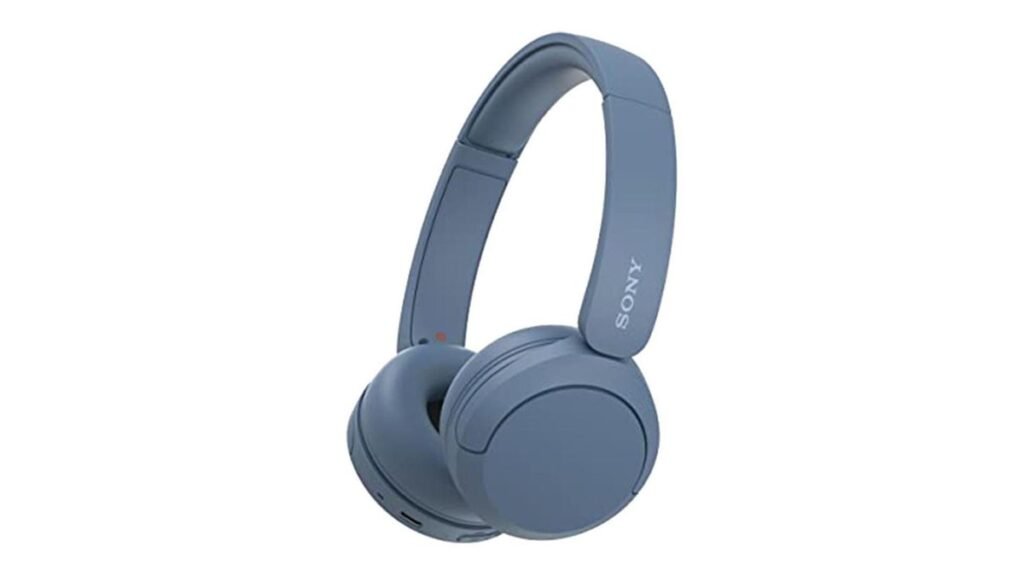
Wireless headphones have quietly become part of the daily uniform in the UAE. They go on before the walk to the car, stay on through a call taken from a mall car park, and come off only when the meeting actually starts. When something is worn that often, the difference between the right pair and the wrong pair is not sound quality alone. It is whether the battery lasts your week, whether callers can hear you over the traffic, and whether the headphones are light enough that you forget they are there.
The good news is that budget wireless headphones have improved enormously. A sensibly chosen pair now does almost everything a flagship did a few years ago. The skill is knowing which corners are safe to cut and which are not. This guide works through the decision in the order that matters most, using a pair we keep on our Sócio shelf, the Sony WH-CH520, as a concrete reference point rather than a sales pitch.
Start With How They Sit on Your Head
The first choice rules out more models than any other: how the headphones physically sit. On-ear pads rest against the ear. They are lighter, more compact, and they breathe, which matters more here than in cooler climates. Over-ear cups surround the ear instead, sealing out more of the world and usually sounding fuller, at the cost of extra weight and more warmth against the skin. In-ear buds are the most pocketable of all, but they trade away battery life and, for many people, all-day comfort.
There is no universally correct answer, only the one that fits your day. If you take a lot of calls, walk between buildings in the heat, and want something you can leave hanging around your neck, an on-ear design like the Sony WH-CH520 is easy to live with. If you mostly listen at a desk or want to feel the low end physically, the over-ear Skullcandy Crusher Evo on the same shelf leans the other way, toward isolation and bass. Decide this first and the field narrows quickly.
Battery Life Is the Feature You Notice Most
Battery life is the specification you feel every single day, long after you have forgotten the marketing. A pair rated for a long run turns charging into a weekly chore rather than a nightly ritual. The Sony WH-CH520, for example, is rated for up to fifty hours, which for most people means topping up roughly once a week rather than every evening. That gap is the difference between headphones that are always ready and headphones that are always flat when you reach for them.
Quick charging is the safety net for the times you forget anyway. Sony rates the WH-CH520 for about ninety minutes of playback from just three minutes on the cable, which is enough to rescue a commute you thought you would spend in silence. When you compare models, read the battery figure and the quick-charge figure together. A big number that takes hours to refill is less useful than a slightly smaller one that recovers fast.
Calls, and the Quiet Luxury of Multipoint
For a lot of people the honest primary use of wireless headphones is talking, not listening. That makes the microphone and the connection quality more important than any sound-quality chart. Look for a clearly stated built-in microphone for hands-free calls, and try to read real user impressions of call clarity in wind and traffic, which are the conditions you will actually use them in.
Then there is multipoint, the ability to stay connected to two devices at once. It sounds minor until you have it. With multipoint, a call landing on your phone interrupts the music playing from your laptop without any menu-diving or re-pairing. The WH-CH520 supports it, and once you have lived with it, going back to headphones that only remember one device feels like a step backward. If you carry both a work phone and a personal one, treat multipoint as close to essential.
Sound You Can Shape
Budget headphones rarely sound bad anymore. They sound different, and the better question is whether you can adjust that difference to your taste. Many pairs now pair with a companion app that offers an adjustable equaliser, so a set that arrives slightly bass-heavy or slightly bright can be nudged toward what you actually like. The WH-CH520 uses the Sony Headphones Connect app for exactly this, with a custom equaliser, and it includes DSEE, a feature that tries to restore some of the detail lost when music is compressed for streaming.
If your priority is a physical, felt low end rather than a tuned balance, that is a genuinely different product category, which is where the bass-forward Skullcandy on our shelf comes in. Neither approach is more correct. What matters is deciding whether you want sound you can tune toward neutral or sound built to emphasise one thing, and then buying accordingly instead of hoping to fix it later.
Comfort, Weight, and the UAE Heat
A headphone you find slightly uncomfortable in the shop becomes genuinely tiring after a three-hour stretch. Weight, clamping force, and the pads all decide whether you keep them on. Lighter on-ear designs win points for all-day wear, especially in the heat, because they let the ears breathe rather than sealing warmth in. Over-ear pads isolate better but can grow warm outdoors, so think honestly about where you will spend most of your listening time.
Everyday care is simple but worth stating. Keep the headphones out of a hot parked car, wipe the pads occasionally, and use the charging port that comes with them, which on modern pairs like the WH-CH520 is USB-C. That last point is a small daily convenience, because it means the same cable charges your phone and your headphones, and one fewer odd cable ends up in your bag.
Portability deserves a thought too, because a pair you leave at home helps no one. Many on-ear models fold flat or swivel to lie against the body, which makes them easy to slip into a work bag or a car door pocket. Over-ear pairs ask for more room, though some fold down as well. If your day moves between an office, a car, and a meeting, the pair you can stash without thinking is the pair you will actually keep reaching for. That quiet practicality matters as much as any single figure printed on the box, and it is easy to overlook until the day you leave the bulky pair behind.
What Budget Should and Should Not Cost You
It helps to be clear about what you are paying for. A good budget pair should buy you dependable wireless, real battery life, clear calls, an app you can actually use, and the reassurance of a trusted maker standing behind it. Those are the basics, and no reasonable price should force you to give them up. If a cheaper model quietly drops the microphone quality, the app, or the fast charging, the saving is not really a saving.
What tends to sit behind the higher prices is a different list: active noise cancellation, plusher materials, and support for higher-quality wireless audio formats. Those are real benefits, but they are wants for many people rather than needs. The honest way to shop is to separate the two. Decide which basics you refuse to compromise, treat those as non-negotiable, and then spend more only for the premium features you will genuinely use rather than the ones that simply sound impressive on a specification sheet.
A Short Checklist Before You Buy
Before you commit, confirm a handful of practical things. Check that the fit, on-ear or over-ear, suits how and where you listen. Confirm the battery is rated for how long you actually go between charges, and that quick charging is there for the days you forget. Make sure there is a clearly stated microphone, and ideally multipoint, if you juggle two devices. Look for a companion app so you can tune the sound, and confirm the charging is USB-C so a single cable covers your phone and your headphones.
One more practical note: a good pair of wireless headphones also happens to be one of the easier tech gifts to get right, because the same qualities that make them a sensible daily buy, comfort and battery and clear calls, are exactly the ones a recipient notices immediately.
Where This Leaves You
The best budget wireless headphones are the ones you stop noticing. They fit, they last the week, they make you clear on calls, and they leave you free to think about the meeting rather than the battery. Everything in this guide is really one idea, which is to match the pair to your day rather than to a spec sheet.
On our Sócio shelf that middle ground is covered by the Sony WH-CH520 for sensible everyday use, and by the bass-forward Skullcandy for people who want to feel the low end. If your days run long and away from a socket, it is worth pairing whichever you choose with a slim battery, and our guide to choosing a magnetic power bank covers that side of the kit. Buy for the ordinary Tuesday, not the demo track, and the right pair tends to choose itself.
—
