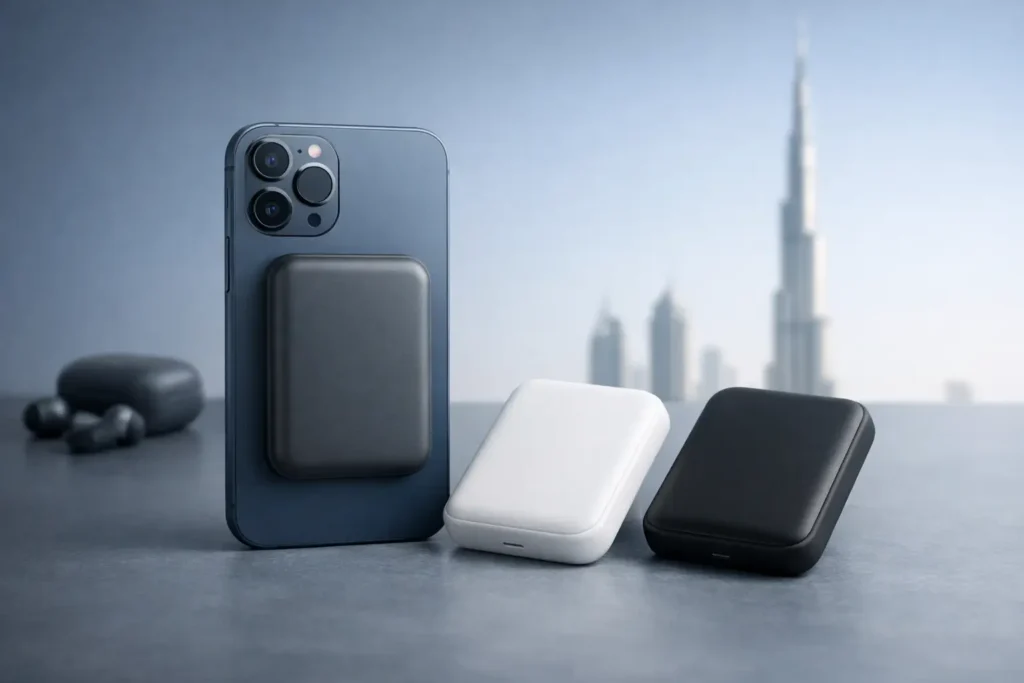
A late meeting, a long drive across Dubai, and a phone at 18 percent changes the value of a compact charger. A magsafe power bank for iphone uae is useful because it removes the cable from that moment: it attaches to the back of the phone and keeps it usable while you move. The right choice, however, is not simply the pack with the largest number on the box.
Magnetic power banks vary in charging speed, thickness, heat control, and grip. Some are designed for a short top-up during a commute. Others are better suited to a full day away from an outlet. Choosing well starts with how you actually use your iPhone, including the case you keep on it.
What a MagSafe power bank does differently
A magnetic power bank aligns its charging coil with the coil in a compatible iPhone. That alignment is the practical advantage. You can hold the phone, check a map, send a message, or take a call without a cable pulling from the charging port.
MagSafe is not just a ring of magnets. Products described as magnetic may attach securely but charge at a lower wireless rate or use a less precise charging standard. A magnetic attachment alone does not establish fast wireless charging. Read the charging specification, not only the product title.
For iPhone users, a MagSafe-certified or Qi2-certified power bank is generally the clearer choice when charging performance matters. Qi2 uses magnetic alignment and is designed to support up to 15W wireless charging on compatible devices. Actual speed still changes with battery level, phone temperature, software behavior, and what the phone is doing at the time.
A pack that offers both magnetic wireless charging and a USB-C port gives you more flexibility. Wireless charging is convenient for daily use. A cable is often more efficient when you need to add power quickly, particularly if you are not using the phone while it charges.
Choose capacity for the day you have planned
Capacity is measured in milliamp-hours, or mAh, but this figure needs context. Power banks store energy at one voltage and deliver it at another, while wireless charging also produces some energy loss. A 5,000mAh magnetic pack should not be expected to provide a full 5,000mAh to the phone battery.
A 5,000mAh model is the most natural choice for many people. It is usually slim enough to stay attached while the phone is in hand, and it can offer a meaningful mid-day charge. This is the format for restaurant reservations, ride-hailing, photos, navigation, and the unexpected long day that follows a normal morning.
A 10,000mAh model holds more reserve, but the trade-off is visible. It is thicker, heavier, and less comfortable in a pocket. It makes sense for frequent travelers, event days, or users who rely on their phone for work and use a high-brightness display, mobile data, and navigation for hours at a time.
Rather than searching for the largest capacity, consider the point at which you usually reach for a charger. If you need to move from 25 percent to a safer level before dinner, a smaller magnetic pack is often the better object to own. If you regularly leave home early and return late, capacity becomes more valuable than slimness.
A MagSafe power bank for iPhone UAE needs heat awareness
The UAE climate adds a practical consideration: heat. Wireless charging naturally generates warmth, and direct sun, a hot car, active navigation, or a demanding video call can add to it. iPhones may slow or pause charging when temperatures rise, which protects the battery but can feel frustrating when you need power.
Choose a power bank with sensible thermal management and avoid treating it as a device to leave charging on a dashboard. When possible, charge in shade, take the phone out of direct sunlight, and remove an unusually thick case. If the phone feels hot, pause charging until it cools rather than trying to force a faster result.
This is also where a wired USB-C option earns its place. Cable charging can be a better choice during a hot outdoor day because it is typically more energy-efficient than wireless charging. The magnetic feature remains valuable when convenience is the priority, but it does not need to be the only way the pack works.
The case matters more than most buyers expect
The magnets in a compatible iPhone are positioned for a specific alignment. A thin case with a built-in magnetic ring can preserve that alignment. A standard case without one may weaken the hold or prevent reliable charging altogether. Thick wallet cases, metal accessories, and uneven surfaces can interfere with the connection.
Before choosing a power bank, identify your case type. If you prefer a leather, silicone, or clear case, look for one explicitly made for magnetic charging. If you use a wallet attachment, remember that it usually needs to come off before charging. Objects between the phone and the pack can create heat and reduce efficiency.
Magnetic strength is about more than avoiding a drop. A secure hold keeps the charging coils aligned as you walk or use the phone. Still, magnetic attachment is not a substitute for a grip when you are moving quickly. A power bank adds weight and changes the balance of the phone.
Details that shape daily use
A good magnetic pack should feel considered from more than one angle. The surface material affects whether it slides against a case. The camera clearance determines whether it works comfortably with larger iPhone camera modules. The position of the USB-C port matters if you intend to charge the power bank while it rests on a desk.
A fold-out stand can be useful for video calls, travel viewing, and a desk setup. It adds a little bulk, so it is not essential for everyone. Likewise, a battery indicator can be more helpful than a single status light if you prefer to know how much reserve remains before leaving home.
Pass-through charging, where a power bank is charged while it charges a phone, sounds convenient but should be treated carefully. Not every model supports it, and it can add heat. If this feature matters to your routine, confirm that the specific power bank supports it and follow its stated guidance.
For travel, check the battery’s watt-hour rating as well as its mAh capacity. Airlines generally set limits around watt-hours for spare lithium batteries carried in cabin baggage, but policies can differ by airline and route. A well-labeled battery makes this easier to assess before a trip.
How to read a product listing with more confidence
Start with compatibility, then assess charging standard, capacity, dimensions, and weight. A listing that names only a large mAh number leaves out much of the story. Look for clear statements about Qi2 or MagSafe compatibility, wired output, input power, and whether a cable is included.
Pay attention to whether the product is described as a power bank, a battery pack, or simply a magnetic wireless charger. These categories overlap, but they are not interchangeable. A magnetic charger needs wall power. A power bank stores its own energy. The distinction matters when you are buying for mobility.
Brand reputation and product documentation are worth considering with any lithium battery accessory. Clear technical specifications, protective features, and straightforward compatibility notes are signs of a product designed for repeat use rather than a vague accessory listing.
The best choice is usually the one that fits your own rhythm. A slim 5,000mAh pack can become part of an everyday carry. A larger model may stay in a work bag for days when your phone does more than usual. Choose the format you will bring with you, then let the magnetic connection make those low-battery moments less disruptive.
