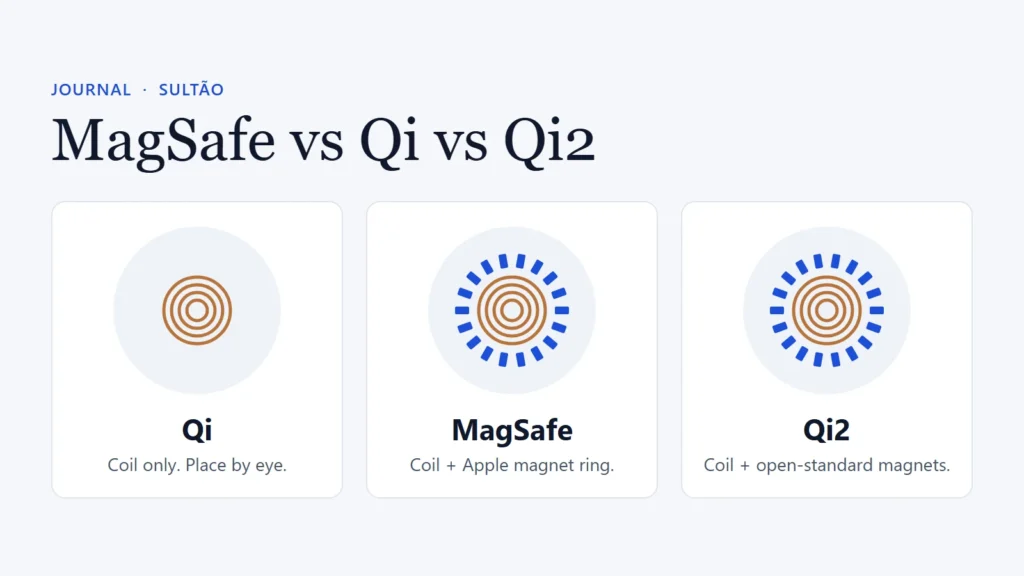
MagSafe vs Qi comes down to one difference: magnets. Qi is the open wireless charging standard that almost every recent phone supports. MagSafe is Apple’s magnetic system, which snaps a charger into the same spot on an iPhone every time. Qi2 then brings that magnetic fit to the open standard, so Android phones can use it too. This guide explains what each name promises, what it does not, and how to read a charger or power bank label before you pay for it.
One note first: Toko sells a magnetic power bank through its Sultão shop. We show where it fits near the end, and we keep the rest of the guide brand-neutral.
MagSafe vs Qi vs Qi2 at a glance
- Qi is the wireless charging standard from the Wireless Power Consortium (WPC). The phone and the charger each have a coil, and power flows when the coils line up. Classic Qi has no magnets, so you place the phone by eye.
- MagSafe is Apple’s magnetic system for the iPhone 12 and later. A ring of magnets around the coil holds the charger in place. With Apple’s newest charger, recent iPhones can take up to 25 W.
- Qi2 is the WPC’s magnetic version of Qi. It launched in November 2023 at 15 W, and Qi2 25W followed in July 2025. It works on iPhones and on a growing list of Android phones.
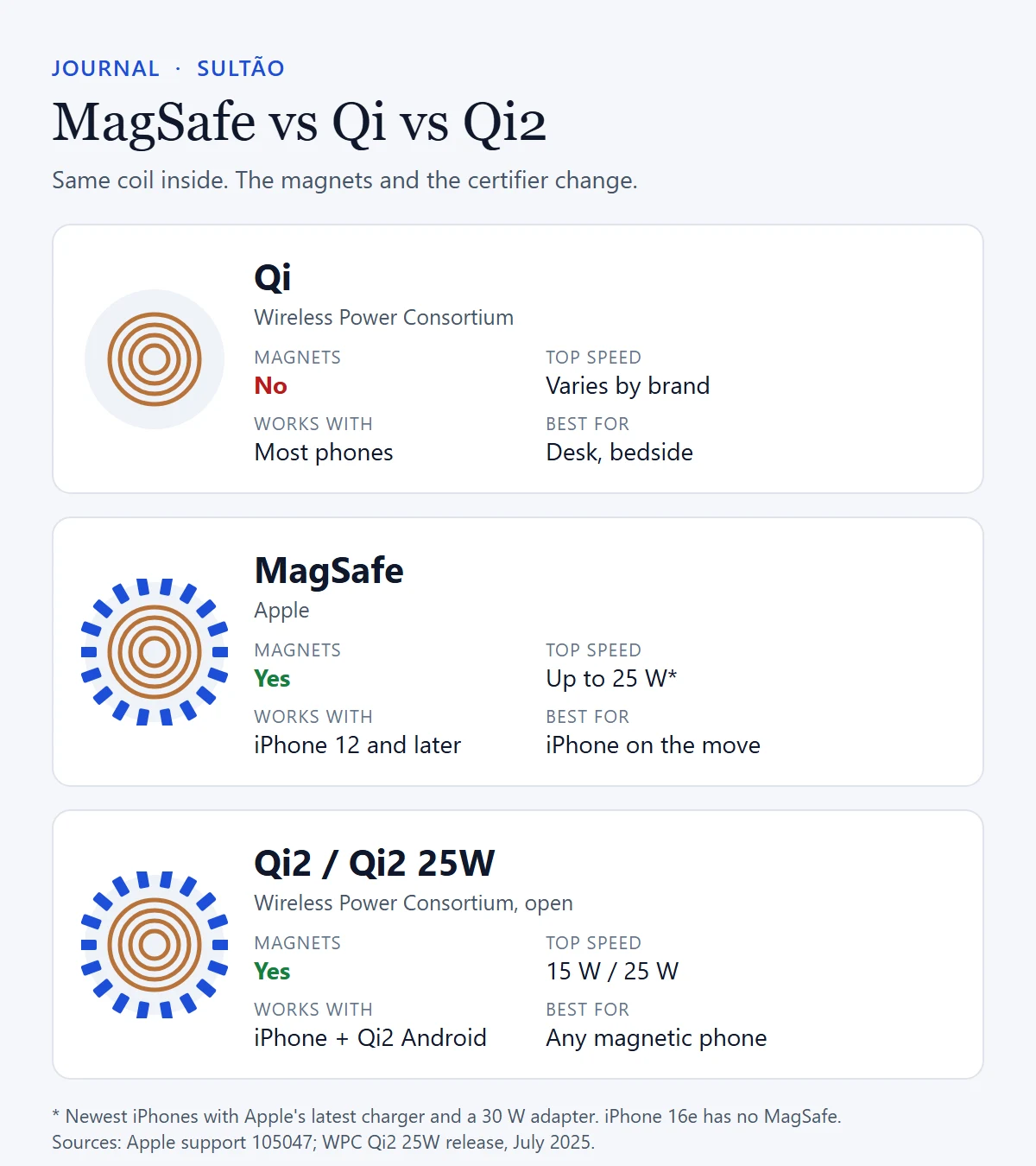
In short, all three charge through a coil. What changes is how the charger finds that coil, and who tests the speed.
What is Qi wireless charging?
Qi (pronounced “chee”) is the standard behind most charging pads, bedside stands and wireless power banks. Every iPhone since the iPhone 8 supports it, and so do most flagship Android phones.
The weak point of classic Qi is placement. The two coils must sit close together and centred. If the phone lands a few millimetres off, charging slows, the phone runs warmer, or charging stops altogether. Even the buzz of a notification can shift a phone on a smooth pad.
Speed was the other gap. Before Qi2, several phone makers built their own fast wireless modes on top of Qi, and the WPC notes that these did not always work across brands. As a result, a plain “Qi” label tells you a charger will work, but not how fast.
What is MagSafe?
MagSafe is Apple’s magnetic accessory system, introduced with the iPhone 12. A ring of magnets around the charging coil pulls a charger, wallet or power bank into one fixed position. That alignment is the whole point. The coils meet the same way every time, even while you walk or hold the phone in one hand.
Speed depends on the iPhone and the charger. According to Apple’s MagSafe Charger guide, the latest MagSafe Charger reaches up to 25 W on recent models such as the iPhone 17, with a 30 W adapter. The iPhone 15 and earlier top out at 15 W. Not every new iPhone has the magnets, though. Apple describes the iPhone 16e as a Qi-compatible phone without MagSafe.
What is Qi2, and where does it fit?
Qi2 is the open-standard answer to MagSafe. It keeps the Qi coil and adds a standard magnetic attachment, based on the design Apple shared with the WPC. Because Qi2 is open, any phone maker can certify a Qi2 phone, and any accessory brand can certify a Qi2 charger.
The first version arrived in November 2023 at 15 W. Then, in July 2025, the WPC announced Qi2 25W, which it says delivers nearly 70% more power than the original. So Qi2 is now a small family: Qi2 at 15 W, and Qi2 25W at the top.
For iPhone owners, the upshot is simple. Recent iPhones work with certified Qi2 chargers as well as MagSafe ones, so a Qi2 accessory is a fair alternative to an Apple-branded one.
MagSafe vs Qi: which charges faster?
Magnets do not make charging faster on their own. Instead, they stop the coils drifting apart, so the charger can hold its rated speed rather than waste power on a poor fit. A well-placed Qi pad and a magnetic charger with the same rating behave much the same.
The real limits are the phone, the charger’s rating and heat. Every wireless charger loses some energy as heat, and every phone slows down when it gets warm. That matters in a UAE summer. Apple says iPhones are designed for ambient temperatures of 0 to 35 °C, and that charging can slow or stop when the phone gets too hot (Apple, on hot and cold iPhones). For example, a phone charging on a car dashboard in July will rarely see its headline wattage.
If speed is the priority, use a cable. USB-C Power Delivery is still the quickest way to top up most phones, and our phone charging standards guide explains the wired options. In other words, choose magnetic charging for convenience and a cable for speed.
How to read a MagSafe vs Qi label
Charger listings mix these terms freely. Here is what each label actually tells you:
- “MagSafe” or “Made for MagSafe”: certified through Apple’s own programme. Expect the full magnetic fit and Apple’s tested speeds on supported iPhones.
- “Qi2” or “Qi2 25W” certified: tested by the WPC for magnetic alignment and the stated power level. Look for the official logo and the exact version.
- “MagSafe compatible” or “magnetic”: the accessory has magnets that fit the MagSafe ring and charges over Qi. It is not certified by Apple or under Qi2, so the wattage is the maker’s own figure, and your phone decides the actual rate.
- “Qi” on its own: wireless charging without magnets. It is fine on a desk, but less useful on the move.
None of these labels is a bad choice by itself. However, each one promises something different, so match the label to how you charge. To check a specific phone or case step by step, see how to verify compatibility on an iPhone.
MagSafe vs Qi on Android phones
Most Android flagships support Qi, so any Qi charger or wireless power bank will charge them. The magnets are the part that varies:
- Built-in magnets: Google’s Pixel 10 series has Qi2 magnets inside the phone, which Google calls Pixelsnap. Magnetic accessories attach directly.
- “Qi2 Ready” phones: some models, such as Samsung’s Galaxy S25 series, support Qi2 charging but have no magnets inside. They need a magnetic case to hold an accessory.
- Qi only: other Qi phones charge well on a pad. To hold a magnetic power bank, though, they need a magnetic case or an adhesive ring over the coil.
Also check the camera bump. A large camera module can stop a flat power bank from sitting flush, even with the right case. Our guide to case compatibility covers that test in about a minute.
MagSafe vs Qi: which should you choose?
Start with your phone, then think about where you charge during the day.
- iPhone 12 or later (except the 16e): go magnetic. A MagSafe or certified Qi2 charger gives the most consistent result, and a magnetic power bank stays put while you use the phone.
- Pixel 10 or another Qi2 phone with magnets: choose Qi2, ideally Qi2 25W if your phone supports it.
- Qi2 Ready or Qi-only Android phone: add a magnetic case first. Otherwise, a plain Qi pad is the simpler buy.
- Mostly at a desk or bedside: a plain Qi stand is enough. Magnets matter most when the phone is in your hand.
Finally, for a power bank, look past the wireless figure. Capacity in Wh, the USB-C output and the thickness decide whether you will actually carry it. Our wireless power bank checklist walks through all seven checks.
Where the Sultão power bank fits
Since we sell one, here is how the Sultão Magnetic Power Bank Ultra Slim reads against this guide. It is a magnetic, Qi-compatible bank. Its magnets fit the MagSafe ring on an iPhone, and it charges any Qi-enabled phone. The listing does not claim Apple MagSafe or Qi2 certification, so read it as “MagSafe compatible” in the sense above.
- 10,000 mAh, about 37 Wh
- Up to 15 W magnetic wireless output
- USB-C Power Delivery up to 20 W, with 22.5 W maximum output
- Aluminium body, 8.5 mm thick, about 200 g
- AED 145, delivered within the UAE
As with any wireless charger, the phone sets the final wireless rate, so use the 20 W USB-C port when you need a quick top-up. For a hands-on verdict, read our full Sultão review. At about 37 Wh, it also sits well under the 100 Wh cabin limit. Before a trip, see flying with a power bank from the UAE for the in-flight rules.
MagSafe vs Qi FAQ
Can a MagSafe charger charge an Android phone?
Yes, if the phone supports Qi. Apple says its MagSafe Charger can also charge Qi-compatible devices. Without magnets in the phone or the case, however, it will not snap into place, so keep the phone flat and centred.
Can a Qi charger charge an iPhone?
Yes. Every iPhone from the iPhone 8 onwards supports Qi. A plain Qi pad has no magnets, though, so placement matters more than it does with MagSafe.
Is Qi2 the same as MagSafe?
Not quite. Qi2 uses the same magnetic alignment idea and works with recent iPhones. The difference is who certifies it. MagSafe is Apple’s programme, while Qi2 is an open WPC standard that Android phones can use as well.
Does a phone case block MagSafe or Qi charging?
A thin case usually lets Qi charging through. A thick case, a metal plate or a card wallet, on the other hand, can block charging or add heat. For a magnetic hold, the case also needs its own magnet ring.
