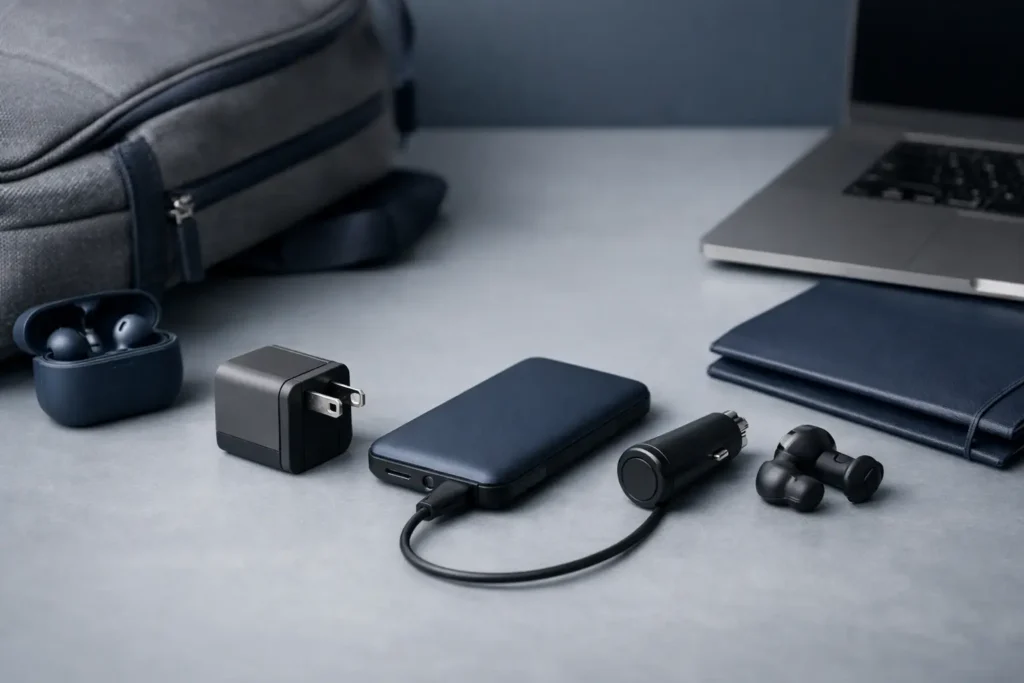
A 4% phone battery at the end of a workday changes a simple plan. Commuter chargers give your phone a practical reserve between the office, the car, meetings, and the journey home. The right one should disappear into your daily carry until you need it.
For most people, the best choice is not the largest battery available. It is the charger with enough capacity for your devices, a cable or magnetic connection that matches how you charge, and a shape you will carry every day.
What should commuter chargers do?
Commuter chargers should cover the gap between two reliable wall outlets. They are designed for daily top-ups, not for replacing a charging station at home or on a long trip.
A phone may lose meaningful battery during navigation, mobile data, calls, messages, music, and video meetings. Add wireless earbuds or a smartwatch, and a compact backup becomes useful even on an ordinary day. The goal is simple: leave work with enough power to use your devices as you normally would.
For UAE commuters, heat adds another consideration. A power bank stored in a parked car can become very warm. Keep lithium-ion batteries out of direct sun and avoid charging a device when either the charger or phone feels unusually hot. A portable charger is best carried in a bag, not left in a vehicle.
How much capacity do you need for commuting?
A 5,000 mAh power bank suits light use and a short commute. A 10,000 mAh power bank is the more flexible daily-carry capacity for most phone users. It gives room for repeated phone charging or for sharing power with earbuds and another small device.
Capacity is measured in milliamp hours, or mAh, but the number is not a direct promise of the same usable capacity in your phone. Power conversion, cable charging, wireless charging, and the phone’s own charging system all use energy. A 10,000 mAh power bank will not place exactly 10,000 mAh into a phone battery.
That does not make the stated number less useful. It helps compare chargers in the same category. The decision is usually a balance between three things: capacity, thickness, and weight. More capacity generally means more of the last two.
Choose 5,000 mAh if you want an emergency reserve that fits easily in a pocket or small bag. Choose 10,000 mAh if your day often extends beyond one location, you use navigation, or you prefer not to think about battery percentage. Consider 20,000 mAh when you routinely carry a tablet, work away from outlets, or take longer trips, knowing it will be less convenient as an everyday item.
Is magnetic charging right for your commute?
Magnetic charging is right for people who want fewer cables in their hands and bags. It is especially useful when you need to check messages, maps, or travel details while your phone charges.
A MagSafe-compatible battery attaches to compatible iPhones magnetically. The connection holds the battery in place while you walk through a station, wait for a car, or move between meetings. It also keeps the phone’s charging port free for a wired accessory if needed.
There is a trade-off. Wireless charging typically produces more heat and is less energy-efficient than a direct cable connection. If you need the fastest possible top-up, or need to recover a nearly empty battery before a meeting, a wired USB-C connection is often the better choice.
The Sultão Magnetic Power Bank Ultra Slim has a 10,000 mAh capacity and MagSafe compatibility. It is listed at AED 145. This format suits an iPhone user who values a clean, cable-light carry while still wanting capacity that goes beyond a single small top-up.
What charging output should you look for?
Charging output determines how quickly a power bank can deliver energy, provided that your phone, cable, and charging method support it. Capacity determines how much energy the power bank stores. Both matter, but they solve different problems.
Look at the input and output specifications before you buy. USB-C is now the most useful connection for many commuters because it can charge newer phones, tablets, headphones, and the power bank itself. A USB-C port that works for both input and output reduces the number of cables you need to pack.
Wireless power banks add convenience, but their speed can vary by phone model and charging standard. Do not assume a magnetic fit means the highest wireless charging rate for every device. Check your phone’s compatibility, especially if you use a case. A thick case, a metal accessory, or an off-center magnetic ring can weaken the connection or prevent charging.
A good commuter setup has one dependable cable even if the power bank supports magnetic charging. Keep a short USB-C to USB-C cable for current phones and tablets, or the cable your device requires. It is the useful fallback when you need more efficient charging or want to charge a second device.
How small should a daily power bank be?
A daily power bank should fit the bag you actually use. If it is too heavy for a jacket pocket, too wide for a small crossbody, or too thick behind your phone, it may stay on your desk instead of traveling with you.
Thin chargers work well for quick phone support and magnetic use. Slightly larger models are easier to justify when they provide multiple outputs or enough capacity for a phone and earbuds. Think about where the battery will sit during charging. A long cable can make a large power bank manageable in a tote, while a magnetic model is more natural in the hand.
Finish and edges matter as well. A charger may share space with a phone, sunglasses, keys, or a notebook. A compact form with a considered surface is easier to hold and less likely to make a bag feel crowded.
What should you carry with your charger?
Keep the kit small. A power bank, one short cable, and the phone you already carry are usually enough. Adding every possible adapter makes the setup less likely to leave the house with you.
If you use wireless earbuds with a USB-C case, one USB-C cable may cover both your phone and earbuds. If your work requires a tablet, choose a cable that can support it and confirm that the power bank output is appropriate for that device. Commuters who switch between a work phone and a personal phone may benefit more from two charging outputs than from an ultra-thin body.
It also helps to recharge the power bank as part of your evening routine. A portable charger is most useful when it starts the day full. Check its indicator before leaving, rather than treating it as a forgotten emergency item.
How do you use a commuter charger safely?
Use the cable that came with your device or a cable made for its charging requirements. Replace cables that are frayed, loose, or visibly damaged. Stop using a power bank that swells, leaks, smells unusual, or becomes excessively hot.
For air travel, check the power bank’s watt-hour rating against your airline’s published limit before packing. Airline rules can differ by carrier and route, and power banks are commonly required in carry-on baggage rather than checked baggage.
Avoid covering a phone and power bank with clothing, bedding, or a tightly packed bag while charging. Give both devices room to release heat. This is particularly relevant after a long day outdoors or during summer commutes, when the phone may already be warm from navigation and mobile data.
The best commuter charger is the one that matches your real routine. Choose the capacity you will carry, the connection you will use, and a charging method that makes a low battery feel like a minor interruption rather than a change of plans.
