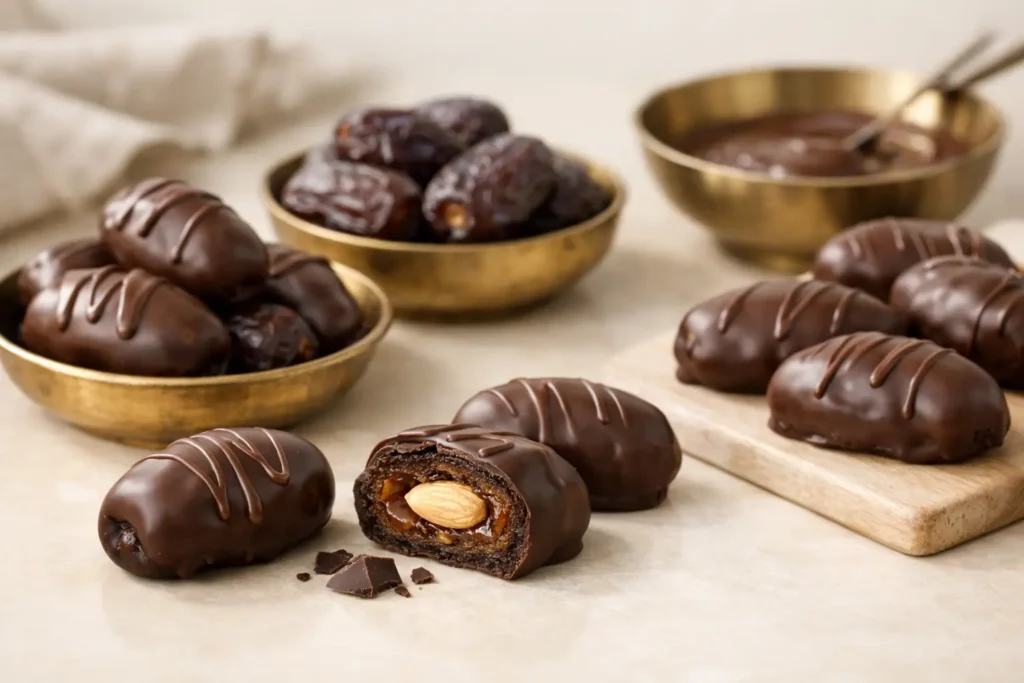
In the UAE, a plate of dates rarely stays on the table for long. It appears the moment a guest sits down, beside a pot of gahwa, at the close of an iftar, or in the quiet middle of an afternoon visit. Dates are not a special-occasion food here — they’re woven into ordinary hospitality. So when you set out a box of chocolate-covered Medjool dates, you’re not introducing something unfamiliar. You’re taking a daily gesture of welcome and dressing it for an occasion.
That’s exactly why they work so well as a gift, and exactly why they’re easy to get wrong. A chocolate-covered date can be a small piece of craft — a plump Medjool, a clean shell of good chocolate, a considered finish — or it can be a tired date drowned in cheap coating to hide its age. Both sit in similar-looking boxes. The price tells you very little; the details tell you everything. This is a guide to reading those details, so the box you give says what you meant it to.
What chocolate-covered Medjool dates actually are
At their simplest, they’re whole Medjool dates — the large, soft, caramel-toned variety prized across the region — pitted and coated, part or whole, in chocolate. Many are left plain inside. Others are filled: a whole almond, a sliver of orange peel, a spoon of pistachio, a touch of sea salt. The chocolate might be dark, milk, or white, and a good maker treats the pairing as deliberate rather than decorative.
The result should taste like two good things meeting, not one thing hiding another. The date brings natural, honeyed sweetness and a fudgy texture. The chocolate brings contrast — a slight snap, a little bitterness, a cleaner finish. When the balance is right, Belgian chocolate-covered Medjool dates manage to feel both familiar and quietly indulgent at once.
What separates a great one from an ordinary one
Here’s where value and price part ways. Two boxes can carry the same price and deliver very different experiences, because the cost of a chocolate-covered date is mostly hidden in things you can’t see through the cellophane.
The date itself
Everything starts with the fruit. A premium Medjool is large, soft, and moist, with a rich caramel flavour that needs no help. A lesser date is smaller, drier, or over-firm — and chocolate is often used to disguise exactly that. The clearest sign of quality is a date that would be worth eating on its own, before any chocolate touches it. If the fruit is an afterthought, no coating will rescue it.
The chocolate
Good chocolate has a clean snap and melts smoothly rather than turning waxy or chalky on the tongue. Cheaper compound coatings — made with vegetable fat instead of real cocoa butter — cost less and tolerate heat better, but they taste flat and leave a dull film. Real chocolate is the more honest pairing for a premium date, and it’s a fair thing to ask about before you buy.
Freshness
Dates are naturally long-keeping, which is precisely why freshness is easy to neglect. A fresh chocolate-covered date is yielding and moist; a stale one turns dense and sugary, sometimes with a pale bloom on the chocolate. Freshness is the single biggest driver of how the gift actually tastes on the day — and the hardest thing to judge from a photo.
Presentation
For a gift, presentation isn’t vanity — it’s part of the message. A considered box, snug spacing, and a restrained finish signal that thought went into the choice. That matters more at Eid, for a host, or in a corporate setting, where the packaging is the first thing the recipient sees and the last thing they forget.
Quick tip: Judge value per experience, not per piece. A smaller box of genuinely excellent dates almost always makes a better impression than a large box of ordinary ones — and costs you less overall.
When they make the right gift
Chocolate-covered Medjool dates suit the occasions where you want to be generous without being personal-to-the-point-of-risky. They ask nothing of the recipient’s taste in the way a gadget or a fragrance might, and they carry genuine regional meaning rather than reading as a generic hamper.
- For a host — restrained and gracious. A box sits naturally on any table and gets shared, which is the point.
- For Eid or Ramadan — dates are already central to both; the chocolate simply lifts a familiar staple into a gift.
- For corporate and client gifting — broadly appreciated, easy to receive, and free of assumptions. Specialty sweets are a dependable answer where a personal object would be a gamble. (Tâmara offers these through its wider gifting range for exactly this reason.)
- For a quiet personal treat — the everyday version of the gesture: something good with your evening coffee.
Buying well in the UAE
A few local realities are worth keeping in mind — they’re where most gifting mistakes actually happen.
- Mind the heat. UAE temperatures are unkind to chocolate. A box left in a hot car or by a sunny window can bloom or soften. Store it cool, and time any delivery so someone is there to receive it rather than leaving it out in the heat.
- Check freshness, not just shelf life. A long best-before date isn’t the same as a date that tastes fresh today. Buy from a source that turns over its stock and describes the product with care.
- Match the box to the moment. A larger, shareable box suits a family gathering or a majlis; a smaller, polished selection suits a one-to-one gift or a personal delivery.
- Confirm what’s inside. Plain or filled? Dark, milk, or white? A good listing tells you, so there are no surprises for someone with a preference or an allergy.
- Look at presentation before you commit. For a gift, how it arrives is part of what you’re giving.
Quick tip: Sending to a household you can’t quite predict? A mixed box — some plain, some filled, a range of chocolate — covers more tastes than a single-flavour selection, without needing to guess.
The real measure of a good box
The value of a chocolate-covered Medjool date isn’t set by the number of pieces or the size of the box. It’s set by the quality of the fruit inside, the honesty of the chocolate around it, how fresh it tastes on the day, and how thoughtfully it’s presented when it arrives. Get those right and even a modest box feels generous. Get them wrong and no amount of ribbon will fix it. Choose for the fruit first, judge value by the experience rather than the price tag, and you’ll give something that tastes exactly as considered as it looks.
