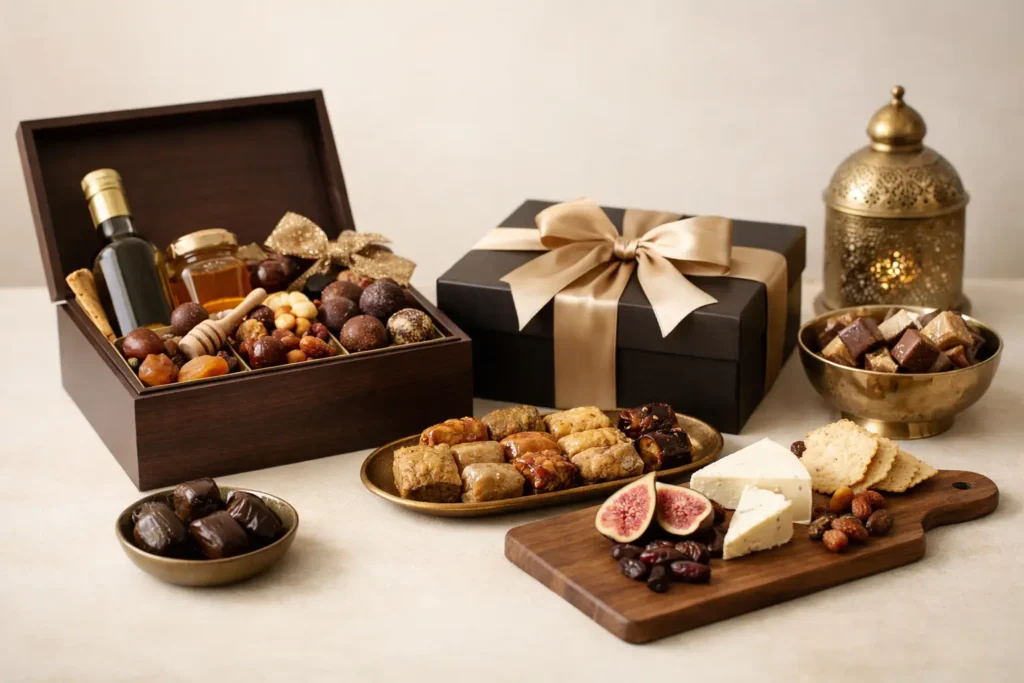
A good food gift is consumed, remembered, and never left looking for shelf space. This premium food gifting guide is for choosing something that feels considered from the first look to the final bite.
The best choice is rarely the largest box or the most elaborate presentation. It is the gift that suits the occasion, respects the recipient’s preferences, and arrives in a format that is easy to share. For professionals in the UAE, that often means a refined edible gift with clear ingredients, a clean finish, and packaging that needs no further explanation.
What makes a food gift feel premium?
Premium food gifting is defined by restraint and specificity. The ingredients should have a reason to be there, the portions should feel intentional, and the presentation should hold its own at a dinner table, office reception, or family gathering.
A premium gift does not need to be unfamiliar. Dates, chocolate, nuts, coffee, tea, and preserved specialties can all feel elevated when quality is evident. Origin, texture, freshness, and balance matter more than novelty alone.
The practical test is simple: would the recipient know when to serve it, share it, or enjoy it without instruction? If the answer is yes, the gift is likely well chosen.
Choose a gift with a clear point of view
A box built around one exceptional idea is often stronger than a mixed assortment with no center. Chocolate-coated dates are a useful example. They connect to regional hospitality while giving the familiar ingredient a more contemporary format.
Tâmara handmade chocolate-coated Medjool dates are pitted, filled with a single roasted nut, and enrobed in single-origin chocolate. Available in 70% dark and 38% milk chocolate, they make the ingredients easy to understand without making the gift feel ordinary.
This kind of specificity is particularly useful when sending a gift to someone whose taste you do not know well. A concise product story feels more confident than an oversized selection that asks the recipient to sort through it.
Who are you buying the food gift for?
The recipient should determine the format before the budget. A host gift, a client gift, and a family celebration gift can all be premium, but they solve different social moments.
For a host, choose something that can be placed on the table immediately. Individually portioned sweets, dates, or a compact confectionery box work well because they are simple to share after a meal or alongside coffee.
For a client or colleague, keep the presentation polished and the flavors broadly appealing. Gifts sent to an office should be easy to divide among a team and should not require refrigeration, utensils, or elaborate serving. Avoid gifts that are highly personal unless you know the recipient’s preferences.
For family occasions, a more generous format can make sense. The gift may become part of the gathering rather than a private indulgence. In that setting, select a food that encourages people to pass, offer, and discuss it.
A small gift can still be appropriate for a senior recipient or an important occasion when it has strong material quality. Thoughtfulness is not measured by volume. It is measured by how naturally the gift fits the moment.
How should you match food gifts to the occasion?
The occasion sets the level of formality. It also helps you avoid a gift that feels too casual, too ceremonial, or simply mistimed.
For Eid, Ramadan visits, or family dinners, dates have a natural place at the table. A chocolate finish and roasted nut filling add contrast while keeping the gesture rooted in a familiar tradition. Choose dark chocolate when the recipient tends toward less sweetness, and milk chocolate when you want a softer, more universally approachable profile.
For housewarmings and dinner invitations, choose a gift designed to be opened with guests present. The ideal format has enough visual appeal to sit beside coffee or dessert, without creating work for the host.
For congratulations, promotions, and business milestones, food is often more appropriate than an object. It acknowledges the moment without assuming someone’s personal style or creating pressure to display the gift. Keep a card message concise: name the achievement, offer your good wishes, and sign it clearly.
For a thank-you gift, detail matters more than scale. A carefully made food gift says that you noticed the effort, advice, invitation, or introduction. This is one occasion where a smaller box with a distinct character can feel especially right.
What should you check before sending a premium food gift?
Check dietary needs, delivery timing, and the recipient’s setting before you finalize the order. These three details prevent most gifting mistakes.
Dietary needs are not a minor detail. If you know the recipient avoids certain ingredients, do not guess. Choose a product with clearly stated components, or ask a brief, direct question through someone close to them. A gift should feel generous, not complicated.
Timing deserves the same attention. Send a host gift before the visit, not after it. For corporate gifting, avoid delivery dates that fall during travel periods, public holidays, or end-of-week office closures. A gift that reaches the recipient at the right moment feels more personal than one that arrives after the occasion has passed.
The setting matters too. A family home may suit a shareable box, while a workplace may call for individually accessible pieces. If the recipient is in another emirate or a GCC country, choose a seller that states its shipping terms plainly. Tâmara offers standard delivery across the UAE and the GCC in 2 to 3 days at AED 25, free above AED 250, with international shipping available.
How much should a premium food gift cost?
Set a budget that reflects the relationship and the occasion, then spend it on quality rather than excess. A food gift should feel generous without becoming performative.
For a casual thank-you, a compact box is usually enough. For a host, a senior colleague, or a family celebration, a larger format may better suit the number of people likely to share it. Corporate gifting requires an additional consideration: consistency. If you are sending several gifts, it is better to choose one well-made item at a consistent level than to vary the gesture from recipient to recipient.
Price also depends on what is inside the package. Single-origin chocolate, Medjool dates, roasted nuts, and handmade assembly add value because they change the eating experience. Decorative packaging has a role, but it should support the product rather than distract from it.
Should you add a message to a food gift?
Yes, when the message gives the gift context. Keep it short enough to read in one glance.
For a host, write: “Thank you for having us.” For a professional milestone, write: “Congratulations on this well-earned achievement.” For a client, a simple note such as “With appreciation for your partnership” is sufficient.
Avoid turning the card into a speech. The food is the gesture. The message simply identifies the moment and the sender.
Why food remains one of the best gifts
Food gives the recipient freedom. It can be shared with family, offered to guests, saved for coffee, or enjoyed quietly at the end of the day. Unlike many objects, it does not ask for permanent space or a particular taste in design.
That flexibility is why premium food gifting works across personal and professional relationships. Choose one product with a clear origin and a thoughtful format, then let the recipient make it part of their own occasion. The most successful gift does not demand attention. It creates a small, welcome pause.
