A smart ring can turn an ordinary night of sleep, a morning walk, or a demanding workweek into a stream of health data. But smart ring accuracy is not a single score. A ring may be highly consistent at tracking overnight heart rate while being less reliable during a fast-paced gym session. Reading the numbers well matters more than treating every number as a verdict.
For shoppers choosing a wearable, the useful question is not whether a smart ring is perfectly accurate. Consumer wellness devices are not clinical instruments. The better question is whether it captures dependable patterns that help you understand your routines, recovery, and readiness to train.
What smart ring accuracy actually measures
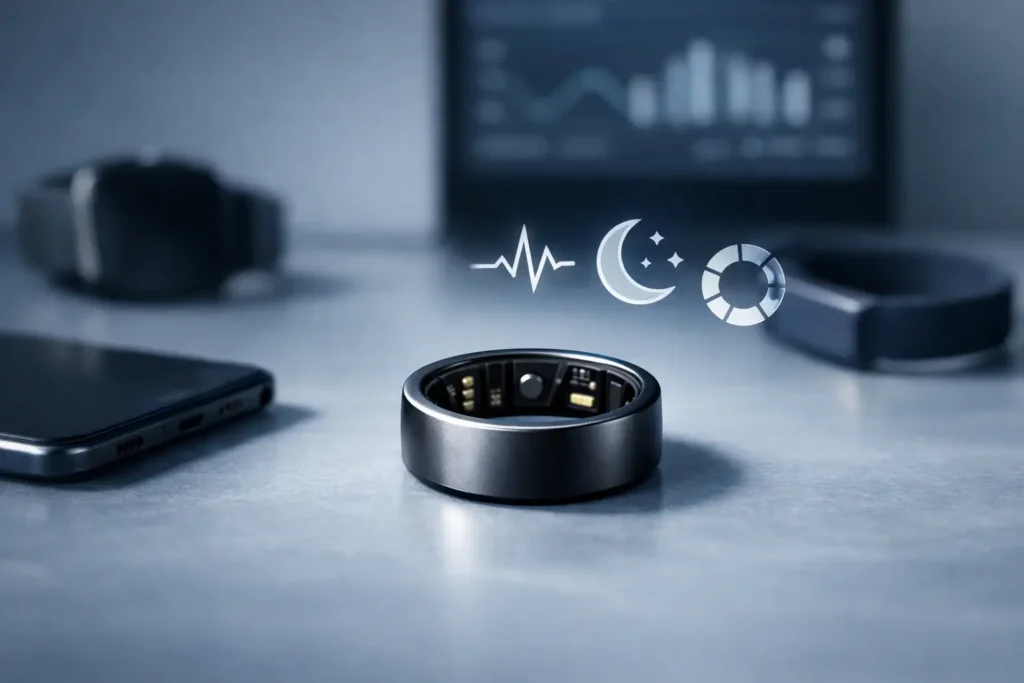
Smart rings use compact optical sensors, temperature sensors, and motion sensors to estimate physiological signals. Their software then turns those signals into metrics such as heart rate, heart rate variability, sleep stages, skin temperature trends, blood oxygen estimates, activity, and recovery scores.
Accuracy changes by metric. Resting heart rate is relatively straightforward when the hand is still and the ring fits well. Sleep timing can also be useful because the device can combine movement and overnight heart-rate patterns. More complex outputs, including sleep stages, calorie burn, stress scores, and readiness scores, are estimates built from several signals. They are best used as directional guidance.
That distinction is worth keeping in mind. A ring does not measure “readiness” directly. It observes inputs associated with recovery and presents an interpretation. A lower score can prompt a thoughtful check-in: Did you sleep less? Train hard? Eat late? Feel unwell? It should not replace your own judgment or medical advice.
Why ring fit affects smart ring accuracy
The ring’s position on your finger is central to data quality. Optical sensors shine light into the skin and read changes in blood flow. If the ring rotates freely, sits too loosely, or leaves a gap between the sensors and your skin, it can lose a clean signal.
A good fit is secure without feeling restrictive. Your fingers naturally change size across the day, particularly after exercise, during warm weather, after salty meals, or on long flights. That makes sizing more than a comfort decision. It is part of the product’s measurement system.
For the clearest baseline, wear the ring on the same finger and in the same orientation whenever possible. Many people find that a finger with a stable circumference provides more consistent readings than a finger affected by frequent swelling. If the ring frequently spins or has to be adjusted, the data may be less dependable.
Skin contact is only one variable. Rings can also be affected by cold hands, which reduce circulation at the fingers, as well as by tattoos, lotions, and dirt on the sensor area. In the Gulf, high temperatures and air-conditioned interiors can create large shifts in comfort and finger size over a single day. Checking fit in both settings is sensible.
The readings that tend to be most useful
The strongest value of a smart ring often appears at night. Sleep is a low-motion period, which gives its sensors a favorable environment. Over several weeks, many users can identify stable patterns in bedtime, wake time, resting heart rate, and heart rate variability.
Resting heart rate is particularly practical because it is easy to interpret in context. A sustained rise from your usual level can follow disrupted sleep, alcohol, illness, travel, dehydration, or unusually demanding training. One elevated reading is rarely meaningful. A gradual shift across several nights can be.
Heart rate variability, usually abbreviated as HRV, needs even more patience. It varies naturally from person to person and from night to night. Comparing your own trend is more useful than comparing your number with someone else’s. A consistent baseline is the reference point that gives this metric value.
Temperature data works in a similar way. A ring’s skin-temperature reading does not necessarily equal a body-temperature measurement. Its advantage is change detection. If your overnight trend moves away from its normal range for several days, that may be useful context alongside how you feel.
Sleep-stage labels deserve a lighter touch. Wearables can make reasonable estimates of light, deep, and REM sleep, but these stages are difficult to confirm outside a formal sleep study. Focus first on total sleep, regularity, interruptions, and how restored you feel. Those signals are generally more actionable than trying to optimize a single stage score.
Where smart rings can be less accurate
Fast, irregular movement is challenging for wrist and ring-based optical sensors. Strength training, racket sports, high-intensity intervals, and exercises involving a tight grip can all introduce motion that confuses heart-rate readings. A ring may still record the session and its general effort, but it may not match the precision of a device designed specifically for real-time workout monitoring.
Calorie estimates also require restraint. They are calculated from models that use movement, heart rate, and personal profile details. They can help compare the relative intensity of your own days, but they are not a precise measure of energy expenditure. Treat them as a broad range rather than a figure to eat or train against exactly.
Blood oxygen estimates are another metric that benefits from context. Readings may change with fit, movement, altitude, and circulation. They can be useful as an overnight trend for some people, but a smart ring should not be used to diagnose or monitor a medical condition. If you have concerning symptoms or an unexpected persistent reading, consult a qualified clinician.
Use trends, not isolated scores
A well-designed smart ring encourages a more measured relationship with health data. The most useful approach is to wear it consistently for two to three weeks before drawing conclusions. That period allows the app to understand your typical range and gives you enough data to see what is normal for you.
Look for connections between the data and real life. Perhaps late dinners correspond with a higher overnight heart rate. Perhaps a consistent bedtime supports better recovery after demanding workdays. Perhaps a hard training session is manageable when sleep is solid but leaves you depleted after travel. These are practical observations, not predictions.
It also helps to avoid changing everything at once. If you are testing an earlier bedtime, keep other habits fairly stable for a week or two. Otherwise, it is difficult to know what influenced the result. The ring supplies feedback, but a simple routine makes that feedback easier to interpret.
A practical check for better data
Before relying on any new metric, compare it with what you already know. If the ring says you slept poorly and you woke repeatedly, the information aligns. If it reports a major change while you feel normal and your routine was unchanged, watch the next few nights before reacting.
A few habits improve the quality of nearly every reading:
- Choose a size that remains secure through normal daily changes in finger size.
- Keep the sensors clean and dry before sleep or exercise.
- Wear the ring consistently, especially overnight, to build a personal baseline.
- Review weekly and monthly patterns rather than repeatedly checking single-day scores.
These steps are modest, but they address the two things smart rings need most: stable sensor contact and enough context.
Choosing a ring for the way you live
The right smart ring depends on the role you want it to play. If sleep, recovery, and discreet everyday wear are your priorities, focus on comfort, sizing options, battery habits, and the clarity of the app’s trend reporting. A ring that feels natural overnight is more likely to produce the consistent data that makes its insights worthwhile.
If live workout data is your main goal, consider the trade-off carefully. A smart ring can complement an active routine, but certain sports may call for a purpose-built training device or no ring at all for comfort and safety. Rings are especially appealing when you want health tracking without another bright screen competing for attention.
For a considered technology purchase, accuracy should be judged over time. The best smart ring does not promise perfect knowledge of your body. It gives you a quiet, consistent record of your patterns, leaving room for the context only you can provide.
